How I Brief a UGC Creator So the Footage Actually Converts
Most UGC flops are decided in the brief, not the edit. Here is the creator brief I send before a single frame is shot, and the approval gate before footage ships.
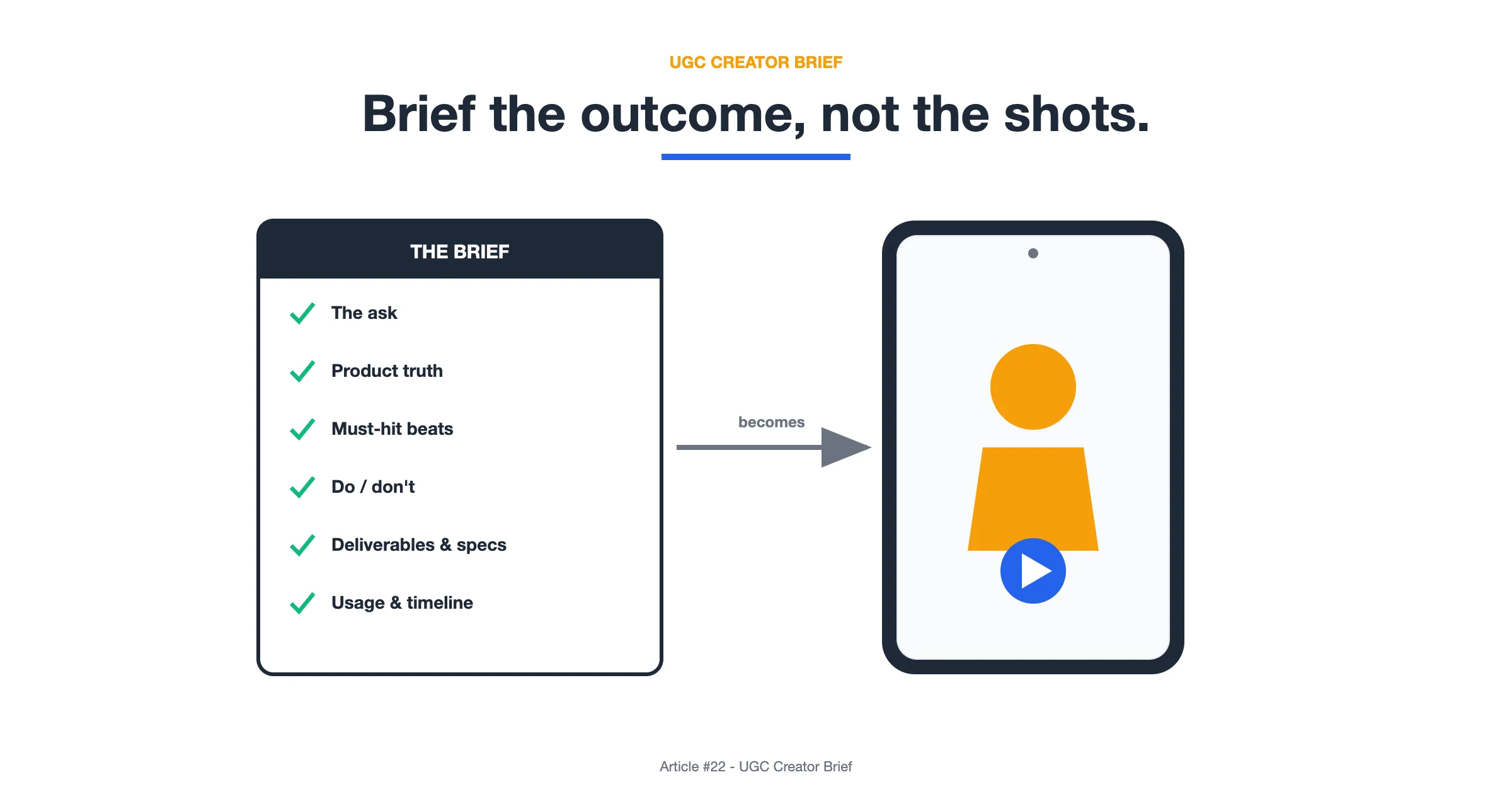
Practitioner playbook — a composite field guide written from the perspective of a Performance Agency Founder. Figures are illustrative, not verified client results.
I run a small performance shop, and most of my creative volume is user-generated-style footage from real creators. Early on I blamed bad UGC on bad creators. It took me a while to admit the uncomfortable truth: most flops were decided before the creator ever picked up a phone. They were decided in my brief. A vague brief produces a confident, on-time, completely unusable video — and the creator did nothing wrong.
So I stopped treating the brief as admin and started treating it as the highest-leverage creative document in the whole process. The creator is a specialist at being on camera and at sounding like a person; I am the specialist at what converts. The brief is where those two jobs meet. What follows is the exact brief I send before a single frame is shot — the six parts, how much I script versus leave to them, the "one body, five hooks" ask, the shot list I require, and the approval gate footage has to clear before it ships.
The Six Things Every Brief Has to Contain
A creator does not need your brand deck. They need enough context to sound convinced, and enough constraint to stay on-strategy. I put six things in every brief, and I have never regretted over-explaining any of them.
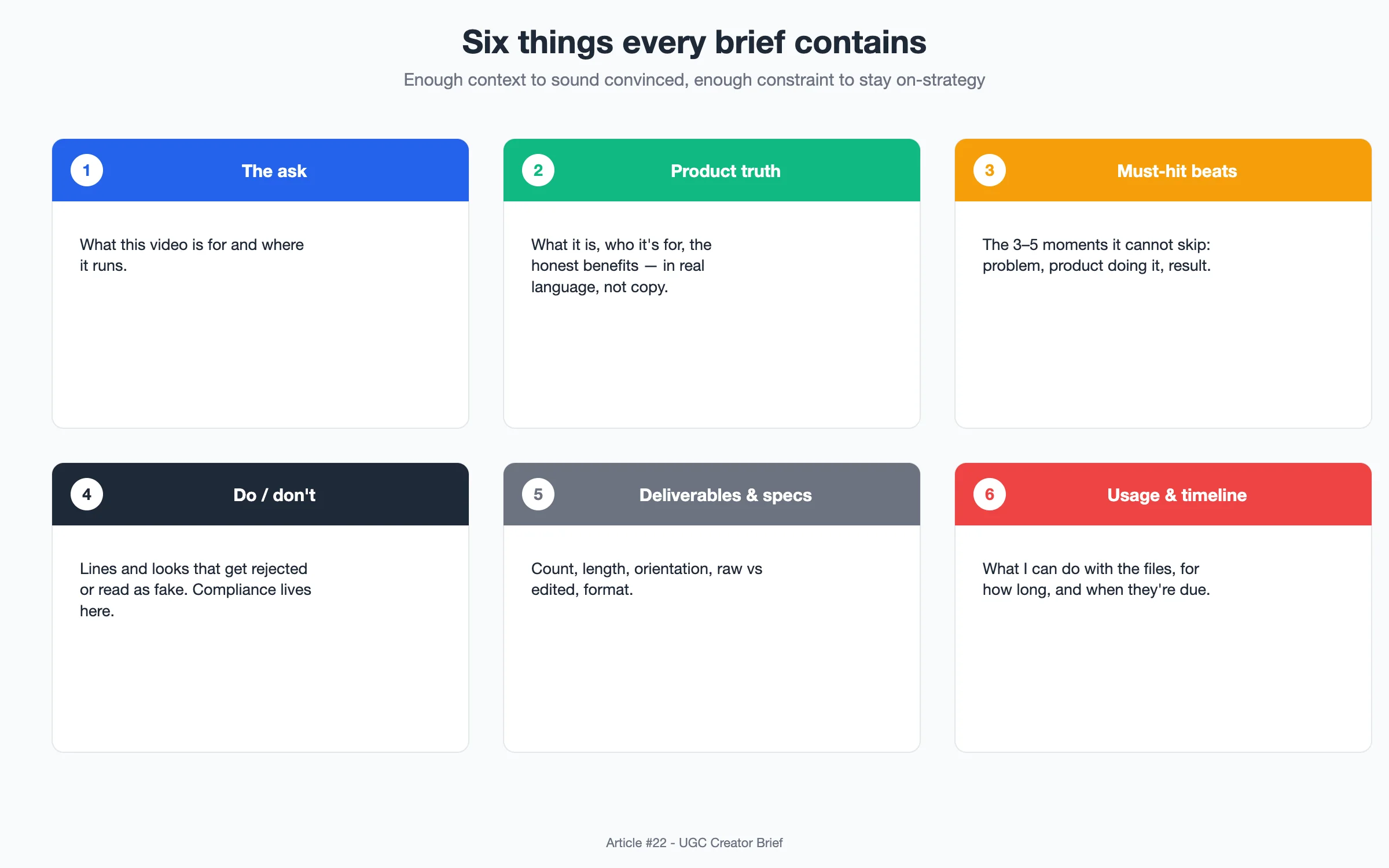
- The ask, in one line: what this video is for and where it will run. "A 20-second sound-off demo ad for a cleaning paste, running as a Meta feed ad" changes everything about how they shoot it versus "a review for my page."
- Product truth: what it is, who it is for, and the one or two benefits we can honestly claim. I give them the real reason I bought it, not the marketing copy, because they can smell copy.
- Must-hit beats: the three to five moments the video cannot skip — usually the problem, the product doing the thing, and the result.
- Do / don't: the specific lines and looks that get an ad rejected or that read as fake. This is where compliance quietly lives.
- Deliverables and specs: count, length, orientation, raw versus edited, file format.
- Usage and timeline: what I can do with the files, for how long, and when they are due.
The mistake I used to make was writing three of these and assuming the rest was obvious. It was not, and "obvious" is expensive when a shoot day is already booked.
How Much to Script, and How Much to Leave Alone
This is the judgment call that separates a brief that gets native-feeling footage from one that gets a stiff read of your words. There is a range, and both ends fail. Over-direct and the creator becomes a teleprompter — it looks like an ad, so it gets skipped like one. Under-direct and you get a lovely, on-brand video that never shows the product doing the thing anyone was supposed to buy.
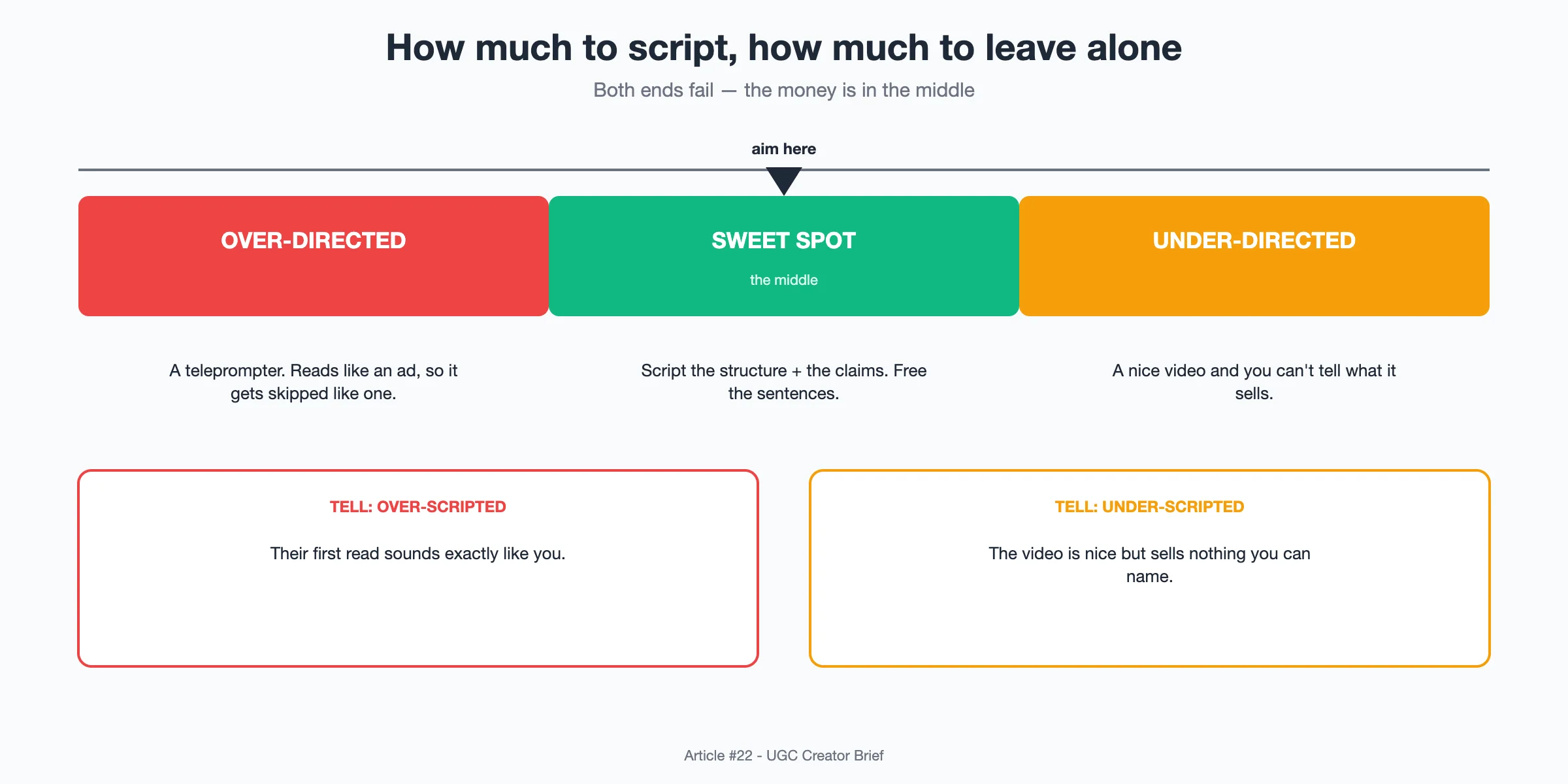
My rule: I script the structure, I never script the sentences. I tell them what has to be communicated and in what order, and I explicitly invite them to say it in their own words. The one thing I do script word-for-word is the claims, because those are the parts that carry legal and accuracy risk — "helps reduce" versus "eliminates" is not a line I let anyone improvise. Everything that is about sounding like a human, I deliberately leave open, because that is the part they are better at than I am.
A good tell that you over-scripted: the creator's first read sounds exactly like you. A good tell that you under-scripted: the video is nice and I cannot tell what it sells.
The "One Body, Five Hooks" Ask
Here is the single highest-ROI line in my brief. I ask the creator to shoot one core body — the demo, the proof, the product doing the thing — and then record five different openings against that same body. The body is expensive to reshoot and rarely the problem. The opening is cheap to vary and is almost always where the ad wins or loses.
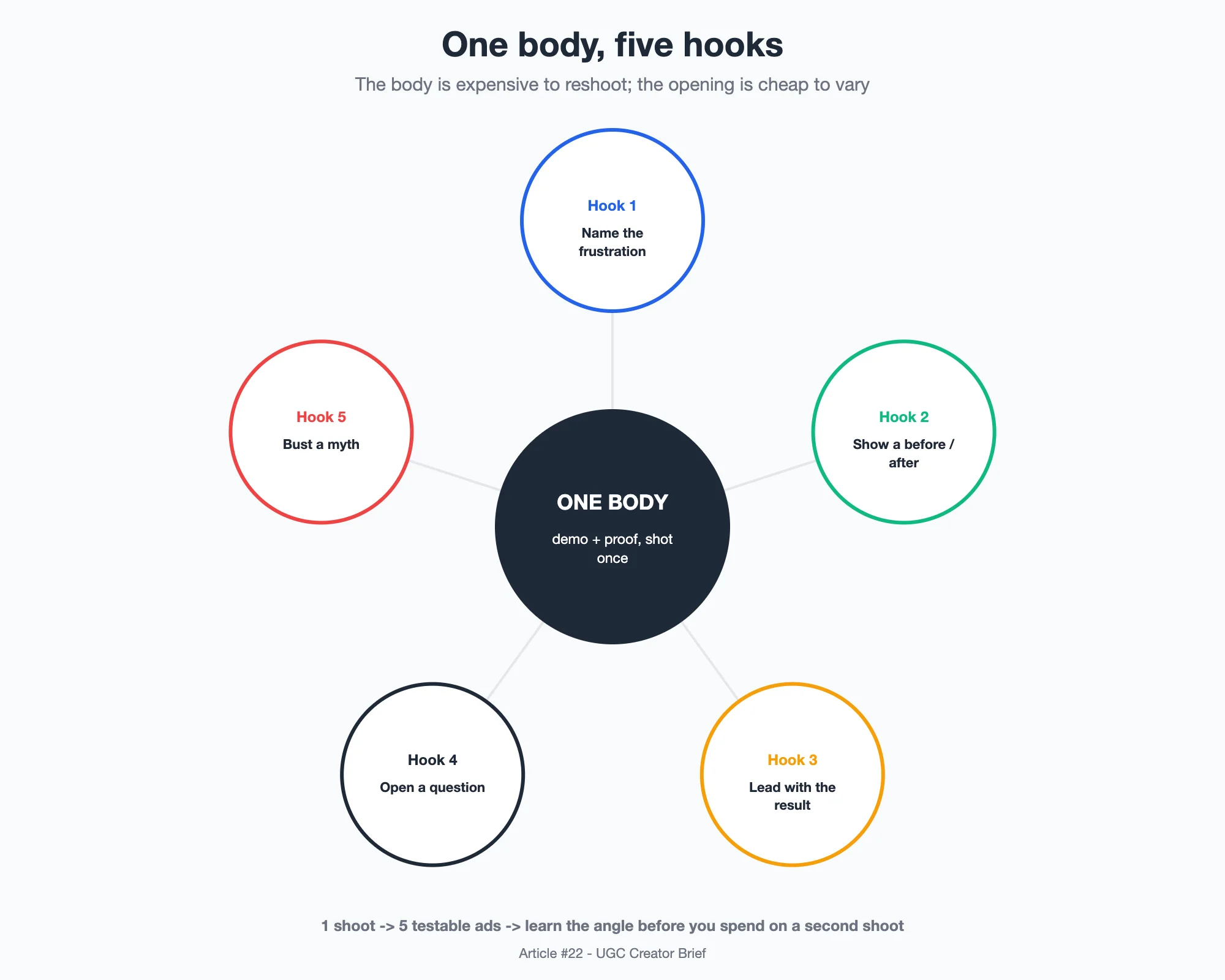
Why this works for me: it multiplies my test surface without multiplying shoot cost. Five hooks on one body is five ads I can throw at an audience, and I find out which angle the market responds to before I spend anything on a second shoot. I give the creator the five hook angles as prompts, not scripts — a frustration to name, a before/after to show, a result to lead with, a question to open on, a myth to bust. They choose the words; I choose which openings exist.
When I budget a creator, this is what I am actually paying for: not one video, but one shoot that yields a testable family of them.
The Shot List I Require Before They Film
A brief that ends in "make it look natural" is a brief that will come back with nothing usable. So my brief closes with a concrete shot list — a checklist the creator can literally tick off — so we both know what "done" looks like before the shoot, not after.
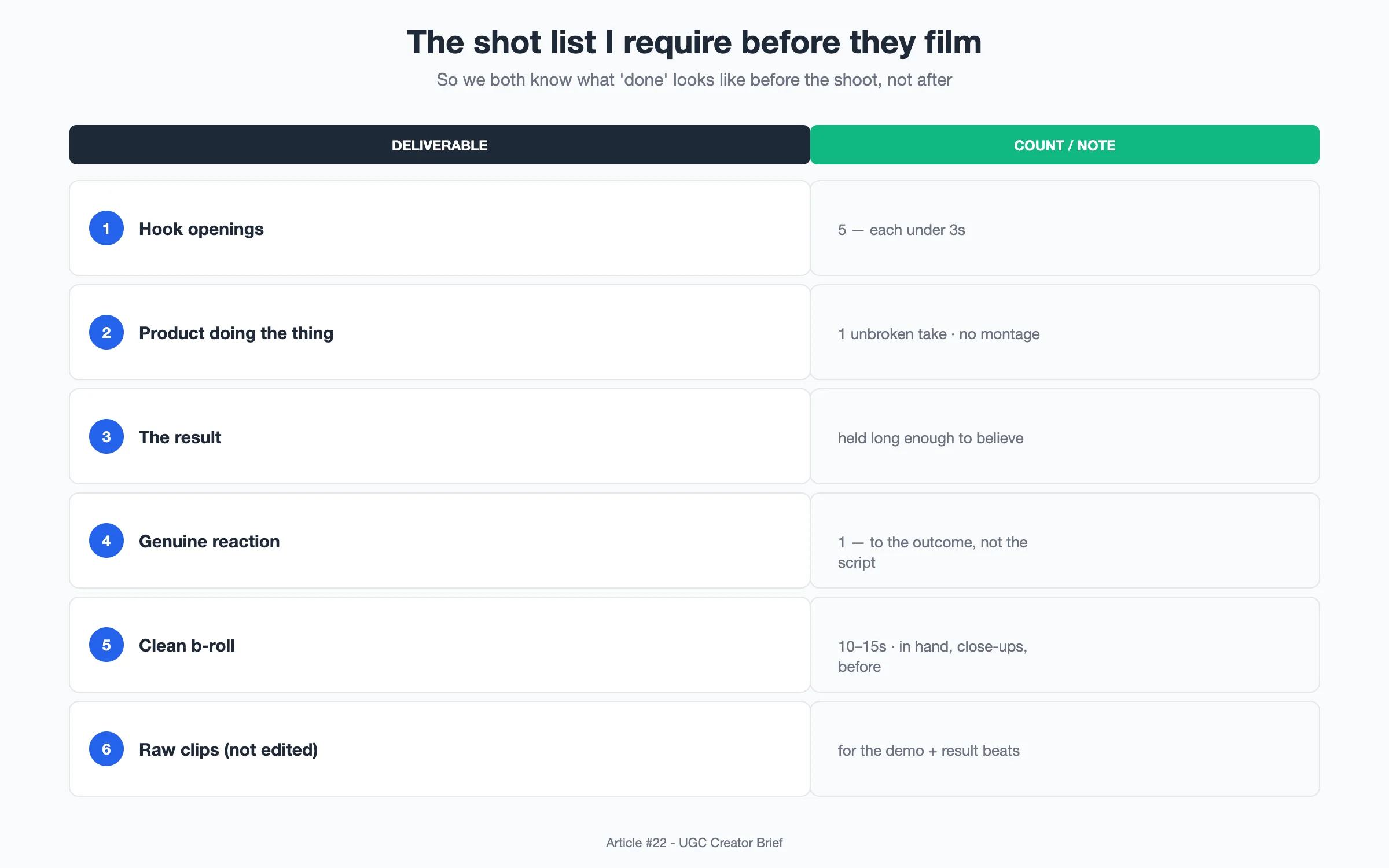
What I ask for on a typical demo product:
- Five hook openings (per above), each under three seconds.
- The product doing the thing, in one unbroken take — no montage. I need the honest version, not the edit that hides whether it works.
- The result, held on camera long enough to believe it.
- A genuine reaction — the moment they respond to the outcome, not to my script.
- Ten to fifteen seconds of clean b-roll: the product in hand, close-ups, the before state. I always ask for more b-roll than I think I need, because it is the cheapest raw material for every future cut.
I ask for raw clips, not a finished edit, for the demo and result beats specifically. A creator's own edit is often charming and completely wrong for a performance ad, and I would rather assemble it myself from honest footage.
The Approval Gate Before Footage Ships
Before any delivered file goes anywhere near an ad account, it clears a short gate. This is boring, and it is the step that keeps a clever video from becoming an expensive problem. I run every clip through the same five checks.
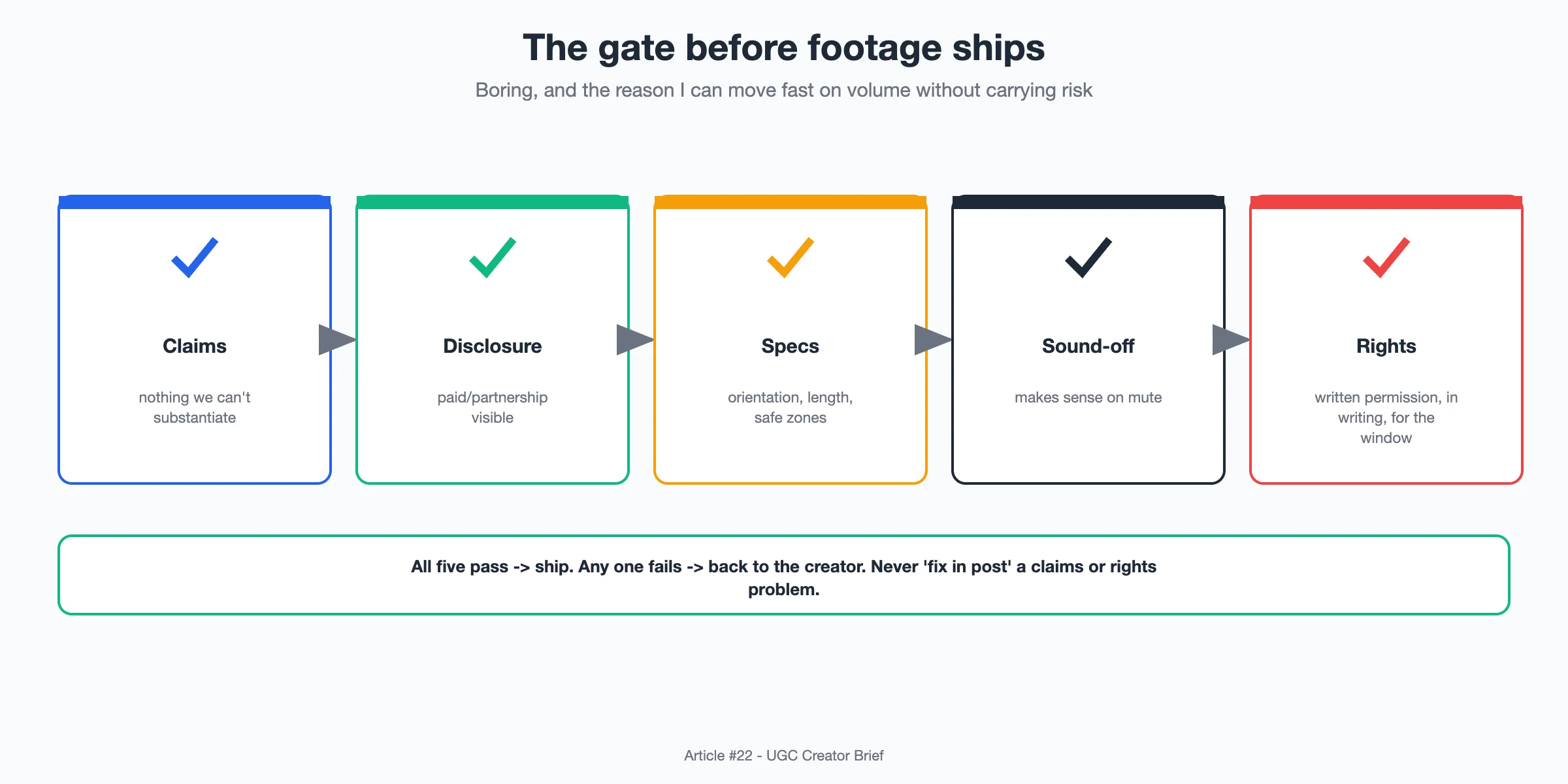
- Claims: does the video say anything we cannot substantiate? If a creator improvised a stronger promise than the brief allowed, that line is cut or re-recorded, no exceptions.
- Disclosure: is the paid/partnership relationship visible per the platform's rules and the FTC's? A native-looking ad still has to be honestly labeled.
- Specs: correct orientation, length, resolution, and safe zones for the placement it is going to.
- Sound-off legibility: does it make sense on mute? If the whole pitch lives in the voiceover, it fails here.
- Rights: do I have written permission to use this footage, in paid media, for the agreed window?
If a clip fails any check, it goes back — I do not "fix it in post" over a claims or rights problem. The gate is where my brief and the actual footage finally reconcile, and it is the reason I can move fast on volume without carrying risk I have to apologize for later.
The Real Question: Did You Brief the Outcome, or the Shots?
The reframe that changed how I produce UGC: a brief is not a list of shots, it is a description of a decision I want a stranger to make. "Show the paste working on the stovetop" is a shot. "Make a skeptic believe this removes a mess in one wipe, without sounding like a commercial" is an outcome — and it lets a good creator solve problems I never thought to specify.
I still give the shot list, because creators deserve clarity. But the moment I started writing the outcome at the top of every brief, the footage got better and the reshoots got rarer. Brief the decision, constrain the claims, free the delivery, and gate what ships. That is the whole job, and it happens before anyone hits record.
Sources:
- FTC Endorsement Guides and platform paid-partnership disclosure rules, which shape the "do/don't" and approval-gate sections of my briefs.
- Meta Business Help Center and TikTok for Business creative guidance on specs, safe zones, and native, sound-off pacing that I check delivered footage against.
- Common creator-marketplace contracting norms (usage rights, deliverable counts, turnaround) that inform the usage-and-timeline part of the brief.
- General direct-response creative practice on testing multiple openings against a common body; the "one body, five hooks" split is my own working default, not a published standard.
Disclosure: This piece is written from a practitioner's perspective to share a working method. It is not a customer testimonial, and any numbers are illustrative examples, not guaranteed outcomes.