How to Reverse-Engineer Any Competitor Ad in 15 Minutes
A repeatable 15-minute SOP for taking apart any competitor's winning ad — log the facts, cut it into beats, name the mechanism, and rebuild the formula for your own product.
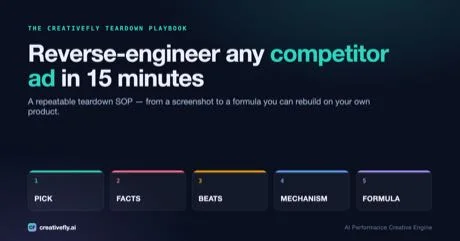
Most "steal this winning ad" posts stop at a screenshot. That's useless. A screenshot tells you what worked, not why it worked or how to reproduce the outcome on a product you've never seen. The skill that actually compounds is reverse-engineering: taking a live winner apart in a quarter hour and walking away with a transferable formula, not a copy.
Here's the exact SOP I run when a competitor's ad is clearly printing money and I want to understand the machine before I touch a single frame.
Step 0 — Pick an ad that's actually winning (30 seconds)
Don't study ads that look good. Study ads that are surviving. The market is the only honest judge, and it shows its verdict in spend.
Two places to find them:
- Meta Ad Library — filter to the advertiser, sort by when they started. An ad that's been live 60+ days, running across multiple placements, with several active variants, is a proven winner. Nobody keeps a losing creative on for two months.
- TikTok Creative Center → Top Ads — filter by your industry, region, and objective. Look for high "conversion rate rank" and ads that have climbed rather than spiked and died.
The tell: longevity + volume + variants. A 3-day spike is a fluke or a test. A 60-day runner with 8 cutdowns is a system.
Step 1 — Log the raw facts (minutes 1–3)
Watch it once, no analysis. Then watch it a second time and write down only observable facts:
- First frame: what's literally on screen at 0:00?
- Opening line (verbatim), and whether it's spoken, on-screen text, or both
- Total length and the length of the first 3 seconds
- Format: UGC, product close-up, screen recording, animation, founder-to-camera
- The offer and the price framing
- The CTA text and where it appears
- Landing page URL and its first viewport
- Which markets / languages it's running in (Ad Library shows this)
Resist interpreting yet. Half of teardowns go wrong because people start with a conclusion and fish for evidence.
Step 2 — Cut it into beats (minutes 3–6)
Rewind and timestamp every time the ad changes job. Most winners map onto five beats:
- Cold open / hook — earns the next second
- Demo — shows the thing working
- Proof — removes doubt (numbers, reviews, before/after)
- Objection handling — answers the "yeah, but…"
- Close / CTA — tells them what to do and why now
You'll notice beats overlap and some ads skip one. That's fine — the point is to see where attention is spent. A 15-second ad that gives 6 seconds to proof and 1 to the close is making a different bet than one that opens on the offer.
Step 3 — Name the mechanism behind each beat (minutes 6–9)
This is the step that separates a teardown from a description. For every beat, answer one question: what psychological lever is this pulling?
- A cold open that starts mid-action is a pattern interrupt — no logo, no intro, the brain has to catch up.
- "I stopped buying X after I found this" is curiosity gap plus loss aversion.
- A price anchor shown before the real price is contrast.
- A comment screenshot or "12,000 sold this week" is social proof doing objection work.
- A countdown or "first 100 only" is scarcity.
Say the mechanism out loud for each beat. If you can't name it, you don't understand the ad yet — rewatch that segment.
Step 4 — Abstract it into a template (minutes 9–12)
Now strip out everything specific to their product and see what's left. Separate constants (the structure, the mechanisms, the beat lengths) from variables (product, offer, audience, hook topic).
Write it as a fill-in-the-blank formula:
Open on [product doing its core action] mid-motion, no intro. Hook: "I [pain I had] until I [product's core promise]." 3s demo of the one feature that [primary desire]. Proof: [specific number or UGC testimonial]. Objection: "It's not [common fear], because [reason]." Close: [offer] + [scarcity], CTA "[verb phrase]."
If the template still only works for their product, you didn't abstract far enough. The test of a good formula: you can point it at a totally different category and it still holds.
Step 5 — Rebuild for your product (minutes 12–15)
Swap your variables into the constants. Keep the beat structure and mechanisms; change the product, the pain, the proof, the offer. Now you have a shot list, not a copy — same machine, different fuel.
Before you generate anything, sanity-check three things:
- Does your hook create the same mechanism (curiosity, pattern interrupt) even with different words?
- Are your beat lengths preserved, or did you accidentally front-load the demo and starve the hook?
- Is your proof specific? "Loved by thousands" is mush; "4.8★ from 2,100 reviews" is a lever.
That's the whole loop. Fifteen minutes, and you've converted someone else's paid-for insight into a repeatable starting point.
The failure modes to avoid
- Copying pixels instead of mechanisms. You'll end up with a worse version of their ad.
- Studying a spike. A 3-day winner is often a test that's about to die.
- Skipping the landing page. Half the "creative" win is actually the post-click offer match. Log where it sends them.
- One data point. A single ad can win for a reason you can't see (a specific audience, a seasonal moment). Find the pattern across three or four winners from the same advertiser before you trust a formula.
Where a tool earns its keep
Steps 2 through 4 are the tedious part — manually scrubbing a timeline, timestamping every beat change, and writing out the shot structure. That's exactly what CreativeFly's reference analysis automates: drop in a winning ad and it breaks it down shot by shot (camera, framing, pacing, transitions, on-screen text, voiceover) so you can read the beat structure and pull the formula without pausing a video for ten minutes. The teardown judgment — naming the mechanism and deciding what to keep — is still yours. The tool just gives you the raw anatomy in seconds so you can spend your fifteen minutes on the part that actually requires a brain.
The SOP works whether you do it by hand or with help. Start by hand until the beats and mechanisms become reflex; then let a tool compress the grunt work.