TikTok vs Instagram Ads 2026: A Merchant's Channel Comparison
TikTok's CPM is $8-12. Instagram's is $15-25. But lower cost doesn't mean better value if your conversion rate is half as good. Here's a merchant's framework for choosing between them.
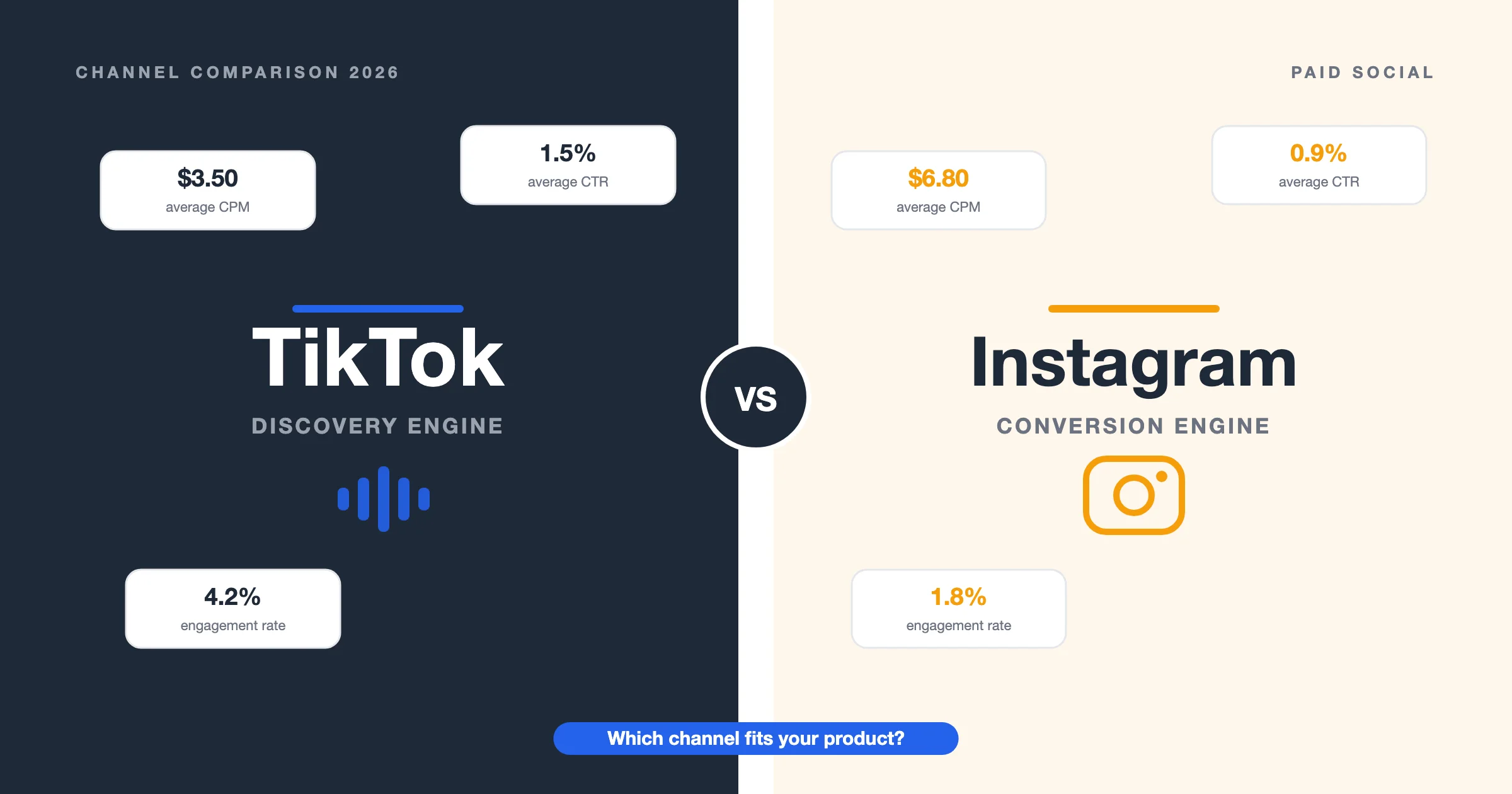
TikTok's average CPM is $8-12. Instagram's is $15-25. But lower cost doesn't mean better value if your conversion rate is half as good.
Merchants choosing between TikTok and Instagram ads in 2026 face a genuine dilemma: TikTok promises discovery and viral potential at low CPM, while Instagram offers predictability and retargeting strength at higher cost. The right answer depends on your product category, business stage, and creative capabilities—not platform rankings.
This article provides a merchant's framework for comparing these channels based on actual 2026 benchmark data, creative requirements, and strategic fit.
What the Benchmarks Actually Say
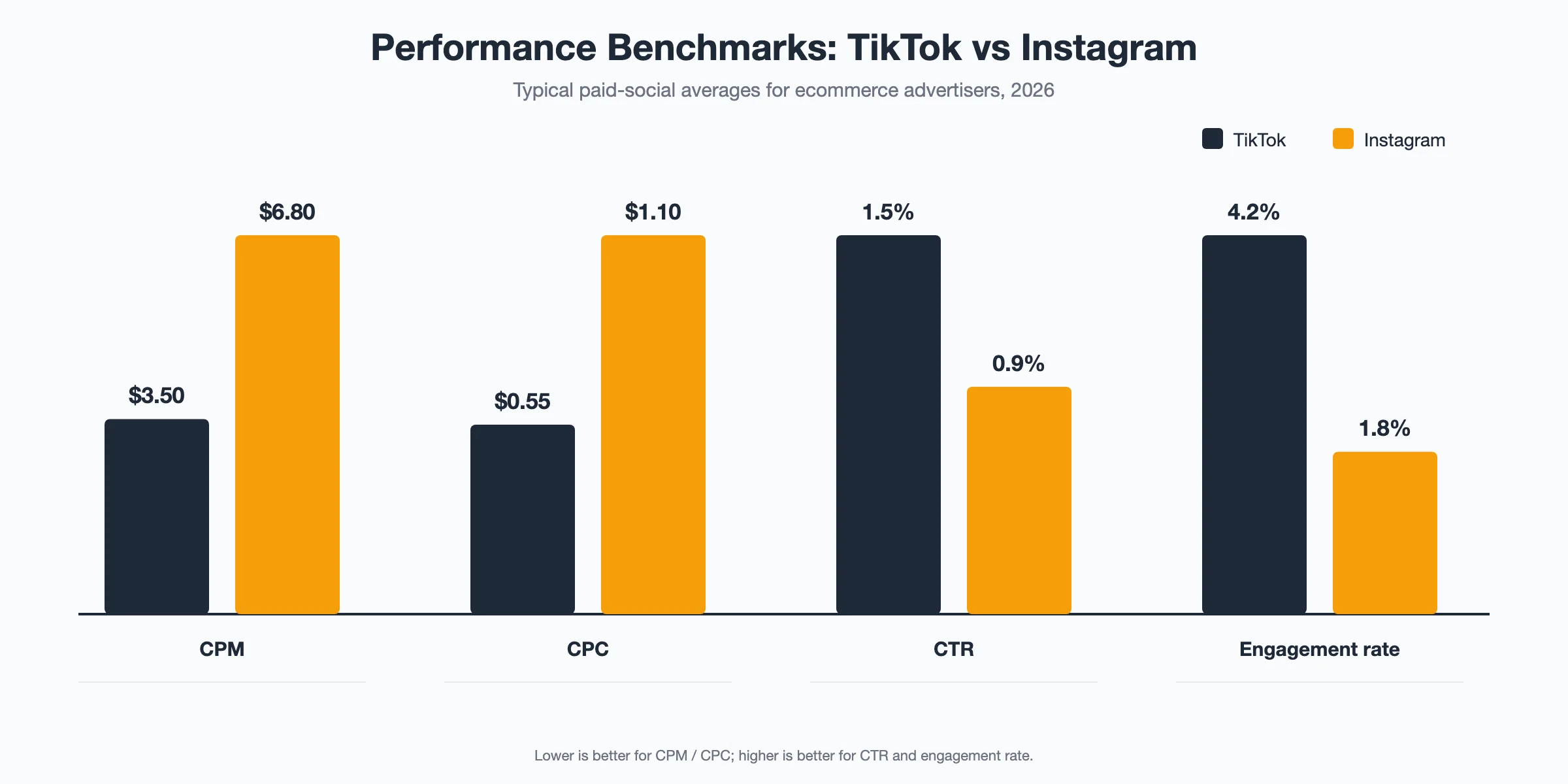
Stackmatix's 2026 analysis and Trendtrack's CPM data provide several anchor points:
TikTok Ads:
- Average CPM: $8-12 (varies by category)
- Average CPC: $0.80-1.50
- Average CTR: 0.9-1.5%
- Conversion rate (to purchase): 1.0-2.0% for e-commerce
Instagram Ads (Meta):
- Average CCPM: $15-25 (varies by category)
- Average CPC: $1.20-2.50
- Average CTR: 0.5-1.0%
- Conversion rate (to purchase): 1.5-3.0% for e-commerce
The numbers tell part of the story: TikTok is cheaper to reach people, but Instagram converts better once they land on your product page. The real question isn't "which CPM is lower?" It's "which channel acquires customers more efficiently?"
Let's build a model for a hypothetical cleaning product brand:
TikTok scenario:
- Spend: $1,000
- CPM: $10 → 100,000 impressions
- CTR: 1.2% → 1,200 clicks
- CVR: 1.5% → 18 sales
- Revenue (avg $50/product): $900
- ROAS: 0.9x (loss)
Instagram scenario:
- Spend: $1,000
- CPM: $20 → 50,000 impressions
- CTR: 0.7% → 350 clicks
- CVR: 2.5% → 8.75 sales (round to 9)
- Revenue (avg $50/product): $450
- ROAS: 0.45x (worse loss)
Wait—this suggests TikTok performs better even with lower conversion rate. But this model assumes equal traffic quality and ignores critical differences:
TikTok advantage: Higher volume at lower CPM means you can test more concepts quickly. Even if individual conversions are less efficient, the learning velocity may justify the economics.
Instagram advantage: Better conversion rates indicate warmer traffic—people already familiar with your brand or actively shopping. This matters for retargeting and high-AOV products.
The channel that wins depends on your objective: discovery versus conversion.
Discovery vs. Conversion: Where Each Channel Excels
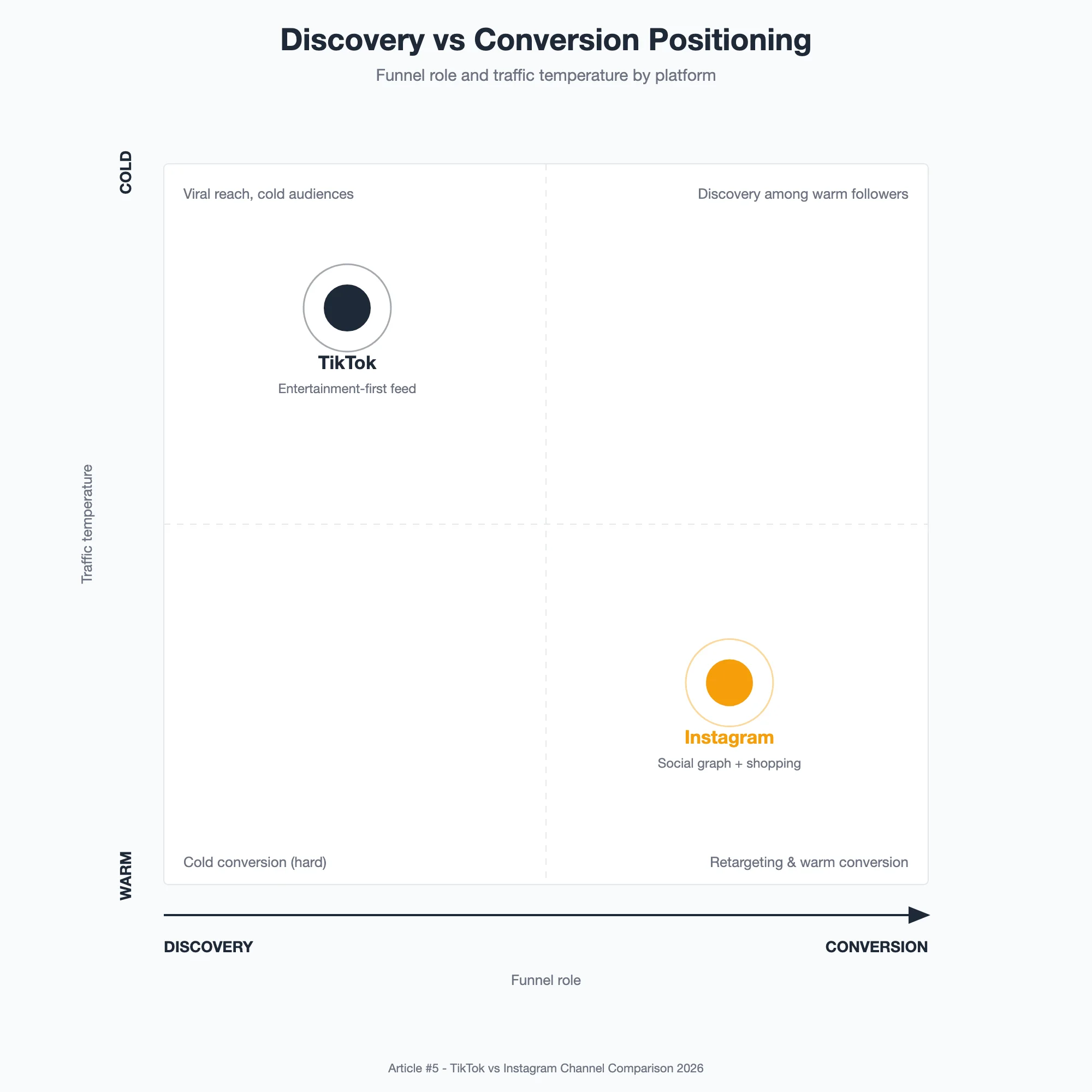
TikTok is a discovery engine. People browse for entertainment, not to shop. Your ad interrupts their scroll with potential interest. This creates friction—but also opportunity.
Advantages:
- Reaches users who don't know they need your product yet
- Viral mechanics can amplify winners organically
- Lower CPM allows testing many creative hypotheses
- Younger demographic (Gen Z, Millennials) aligns with impulse categories
Disadvantages:
- Cold traffic requires exceptional creative to convert
- Purchase intent is low; you're building demand, not capturing it
- Attribution windows shorter (often 1-day click) may undercount delayed conversions
- Creative fatigue faster due to high-volume consumption patterns
Instagram is a conversion engine. People check feeds expecting to see friends' content and brands they follow. Your ad feels less intrusive because you've built some prior awareness.
Advantages:
- Warmer traffic with higher baseline intent
- Better for retargeting website visitors or engagers
- Longer attribution window (7-day click, 1-day view) captures more conversions
- Shopping features (product tags, shop tab) reduce friction
Disadvantages:
- Higher CPM means slower, more expensive testing
- Saturation risk: users see many ads daily, leading to banner blindness
- Demographic skew older than TikTok (Millennials, Gen X)
- Viral mechanics weaker; organic reach minimal without paid support
Strategic implication: Use TikTok for top-of-funnel awareness and Instagram for mid-to-bottom funnel conversion. Most successful merchants run both, not one or the other.
Creative Requirements That Separate Winners from Losers
Both platforms reward native-looking content, but the specifics differ:
TikTok creative principles:
- Hook in 1-2 seconds: No intro sequences; start with the transformation or problem immediately
- Vertical-first: 9:16 aspect ratio mandatory; horizontal feels like an ad
- User-generated aesthetic: Phone-quality footage outperforms polished production
- Sound-on design: 85%+ of TikTok viewed with audio; don't rely on captions alone
- Trend participation: Using trending sounds or formats boosts algorithmic distribution
- Length flexibility: 15-30 seconds sweet spot; anything over 60 seconds needs exceptional retention
Instagram creative principles:
- Polished but authentic: Higher production value acceptable; still needs to feel native
- Format variety: Feed (4:5 or 1:1), Stories (9:16), Reels (9:16)—each has different norms
- Visual hierarchy: Product should be visible within first frame even without sound
- Caption importance: Text overlay supports visual message; longer captions acceptable
- Length preferences: Reels 15-30 seconds; Stories 15 seconds per slide; Feed 30-60 seconds acceptable
- Shoppable integration: Product tags must be clear and accessible
The hard truth: If you only have budget for one creative style, TikTok demands more iteration. You might need 50 variations to find 2-3 winners. Instagram rewards fewer, higher-quality assets. Your creative production capacity should inform channel selection.
Category Fit: Which Products Thrive Where
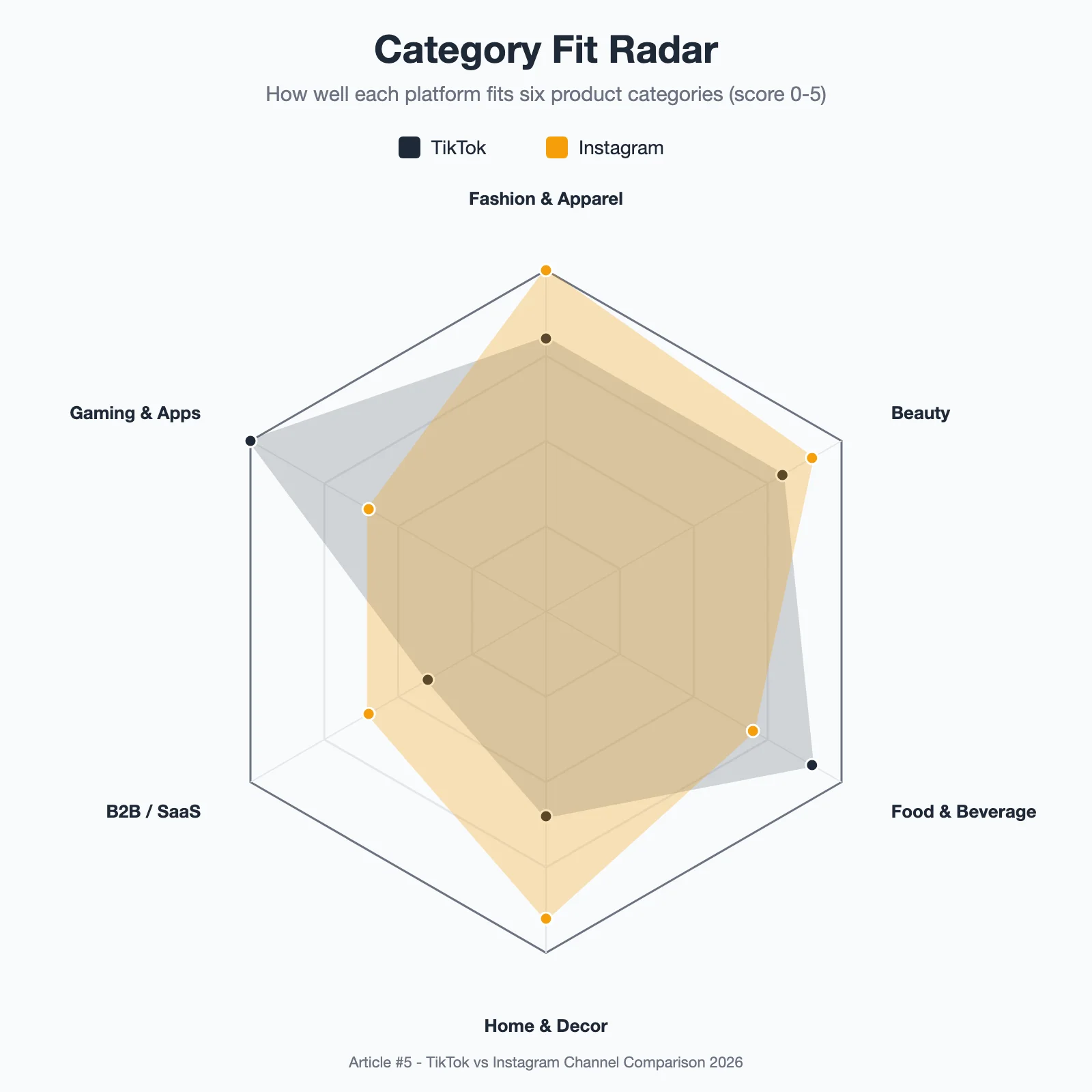
Not all products work equally well on both platforms. Here's how different categories perform:
Strong on TikTok:
- Impulse buys under $50 (accessories, beauty samples, kitchen gadgets)
- Visually dramatic transformations (cleaning products, before-after skincare)
- Trend-driven categories (fashion, home decor, fitness equipment)
- Novelty items people haven't seen before
Strong on Instagram:
- Higher AOV products ($100+) requiring consideration
- Established brands with existing awareness
- Fashion and beauty with strong visual identity
- Lifestyle products fitting into aspirational narratives
Neutral (works on both):
- Electronics and tech accessories
- Pet supplies
- Health and wellness supplements
- Home organization
If your product falls into "strong on TikTok" categories, prioritize TikTok for launch. If it's "strong on Instagram," start there and add TikTok later for incremental reach.
Budget Allocation Models for Multi-Channel Strategy
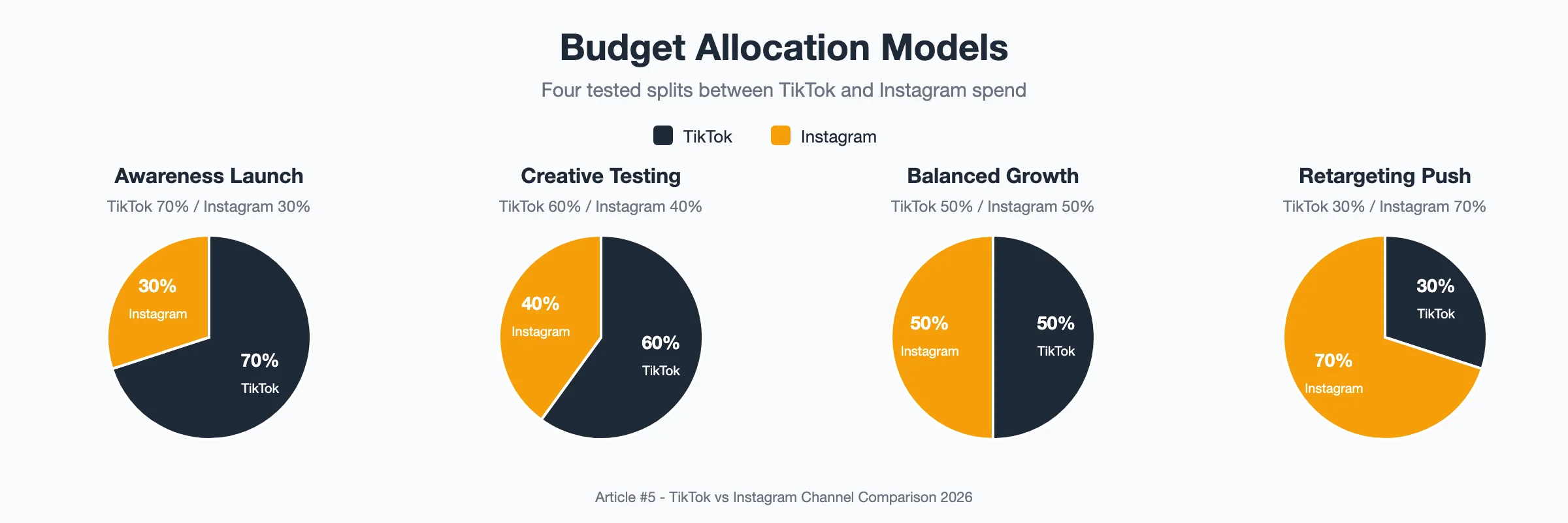
Once you decide to run both channels (recommended), how do you split budget?
Model A: Funnel-based allocation (Recommended for most)
- 60% TikTok (top-of-funnel discovery)
- 30% Instagram feed/reels (mid-funnel consideration)
- 10% Instagram retargeting (bottom-funnel conversion)
Model B: Testing-focused allocation (Early-stage merchants)
- 80% TikTok (rapid creative hypothesis testing)
- 20% Instagram (baseline performance comparison)
Model C: Performance-focused allocation (Scale-stage merchants)
- 30% TikTok (incremental reach expansion)
- 40% Instagram feed/reels (core conversion driver)
- 30% Instagram retargeting (maximize ROI on warm audiences)
Model D: Category-specific allocation
- Impulse categories (<$50): 70% TikTok / 30% Instagram
- Consideration categories ($100+): 30% TikTok / 70% Instagram
- Hybrid categories ($50-100): 50% TikTok / 50% Instagram
Start with Model A or D based on your category. Adjust quarterly based on incrementality measurements.
When to Skip One Channel Entirely
Running both channels isn't always optimal. Consider skipping TikTok when:
- Your product requires extensive explanation (complex B2B software, specialized equipment)
- Your target demographic is 45+ (skews heavily Instagram/Facebook)
- Your creative team can't sustain 20+ monthly TikTok-native variations
- Your AOV exceeds $200 and you need high-intent traffic only
Consider skipping Instagram when:
- You're targeting Gen Z exclusively (TikTok dominates their attention)
- Your budget is <$5,000/month and you need volume to learn quickly
- Your product is visually dramatic and benefits from TikTok's viral mechanics
- You want to test new markets where TikTok penetration exceeds Instagram
The goal isn't universal coverage. It's efficient customer acquisition within your specific constraints.
The Real Question: What Are You Trying to Learn?
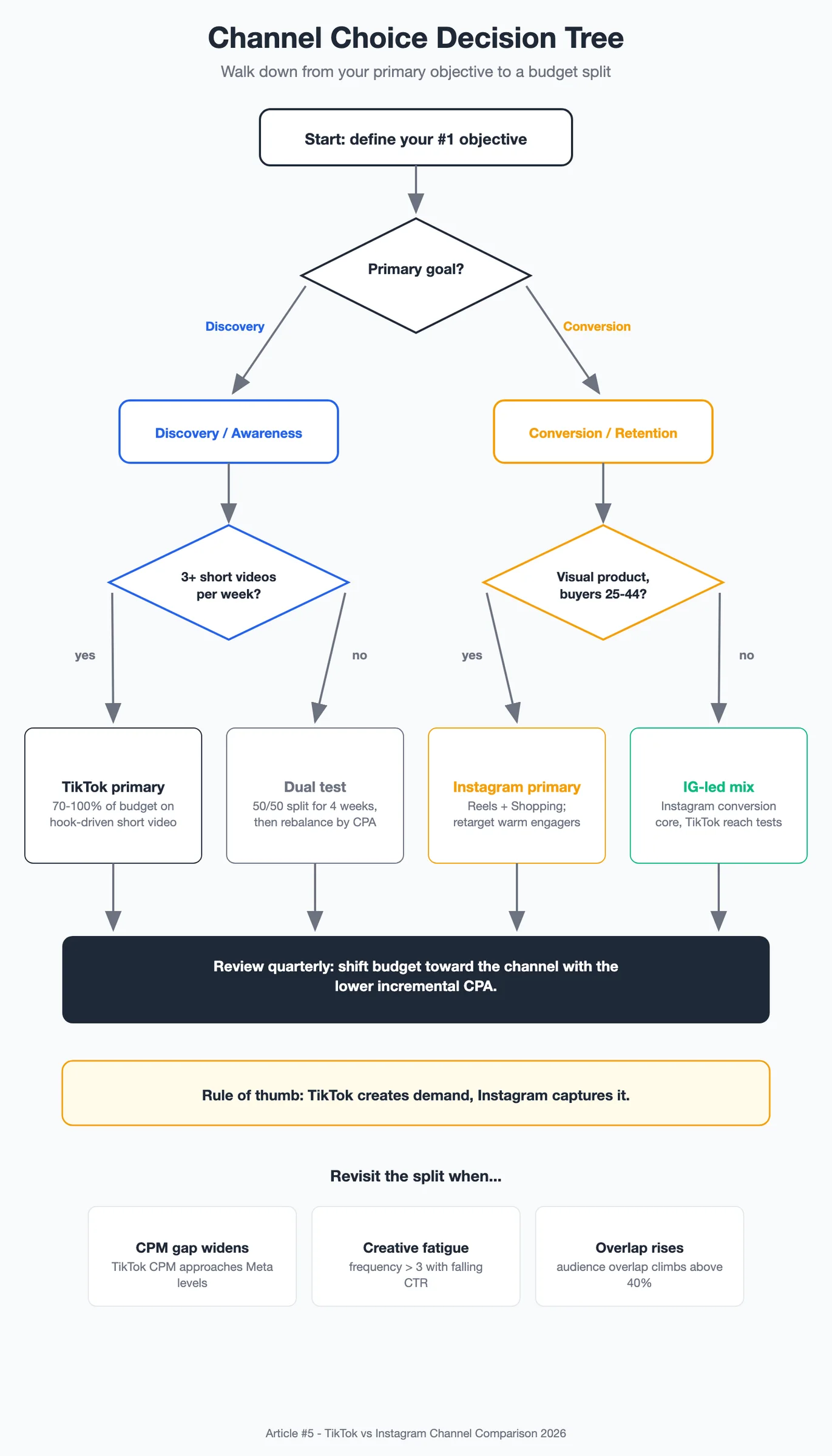
Before allocating budget, clarify your objective:
"I need to validate whether my product resonates with cold audiences." → Start with TikTok, measure creative hypotheses rapidly.
"I need to scale profitable customer acquisition." → Start with Instagram retargeting, expand to warm audiences, then test TikTok for incremental reach.
"I need to build brand awareness for a new launch." → 70% TikTok (viral potential), 30% Instagram (visual identity control).
"I need to clear inventory quickly." → Both channels, but prioritize TikTok for volume and Instagram for conversion efficiency.
Your objective determines your channel mix more than benchmarks do. Use data to inform decisions, not replace judgment.
Sources:
- Stackmatix Complete TikTok Guide 2026 – Platform specifications and best practices
- Stackmatix TikTok vs Instagram 2026 – Direct comparison data
- Trendtrack CPM Benchmarks – 2026 CPM data across categories
- MBBrowser TikTok vs Instagram Comparison – Cross-platform strategy insights