Meta Advantage+ Audience Expansion: When It Helps and When It Hurts
Advantage+ audience expansion works like a double-edged sword: it finds customers you couldn't reach manually, but it also spends budget on people unlikely to convert.
Advantage+ audience expansion works like a double-edged sword: it finds customers you couldn't reach manually, but it also spends budget on people unlikely to convert.
Meta's Advantage+ Shopping Campaigns automatically expand your audience beyond specified targets, using machine learning to find converters. This automation solves real problems—audience overlap, manual bid adjustments, creative fatigue. But it also creates blind spots where budget leaks into low-intent placements or audiences that look good on paper but don't purchase.
The core question isn't whether Advantage+ audience works—it often does when you have strong conversion data and broad product appeal. It's whether you're making informed decisions about when to trust automation versus when to retain manual control.
What Advantage+ Audience Actually Does
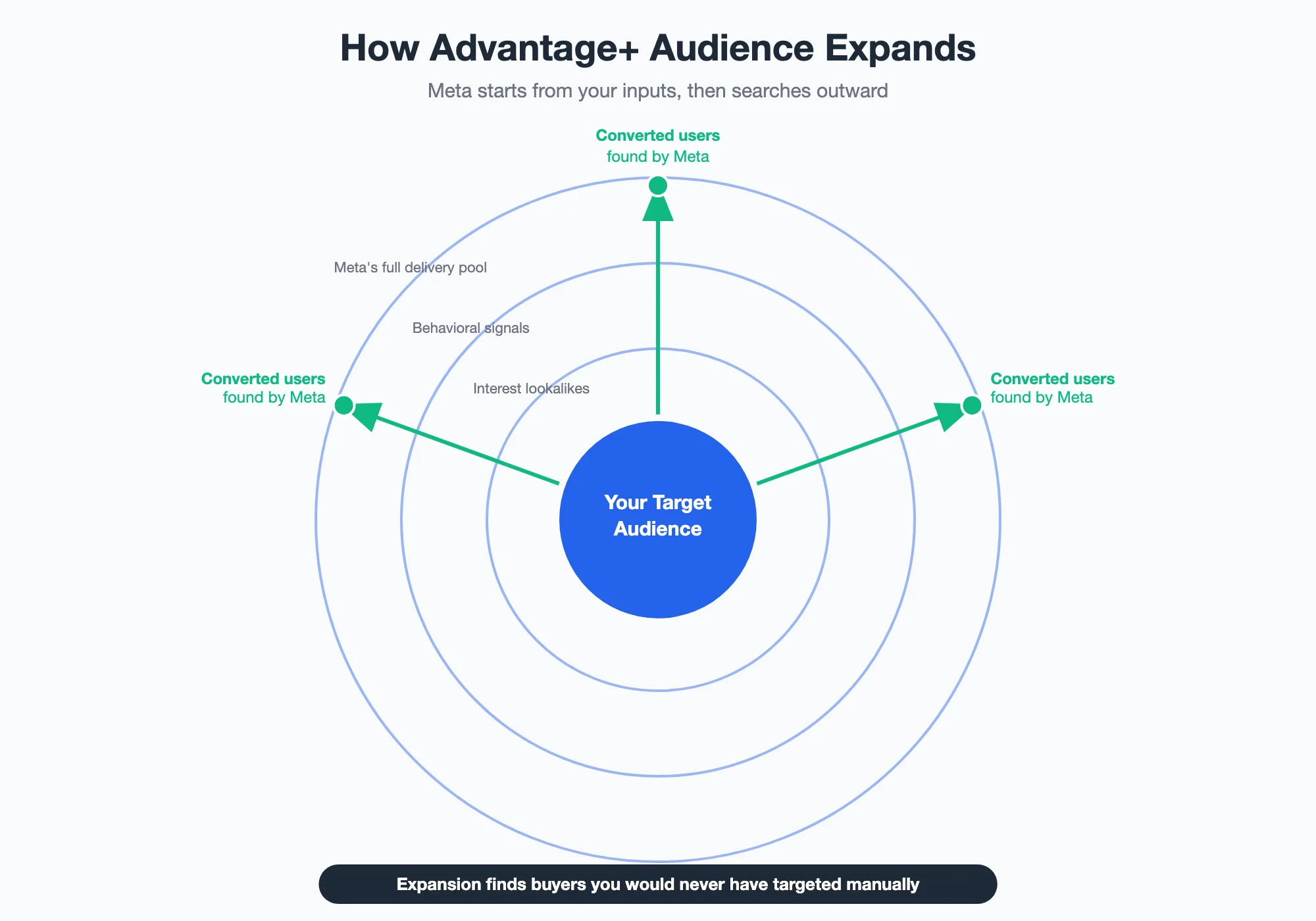
When you enable Advantage+ audience, Meta's algorithm:
Expands beyond your specified targets: If you select "women 25-45 interested in home decor," Advantage+ may show ads to men 18-34 who behave similarly to your converters, even though they weren't in your original targeting.
Tests audience combinations: The system tries different demographic, interest, and behavior combinations to find what drives conversions, often discovering patterns you wouldn't have tested manually.
Prioritizes by conversion probability: Instead of showing ads equally across your target audience, Advantage+ focuses spend on users most likely to convert based on platform-wide signals.
Optimizes across placements: Automatic placement optimization works hand-in-hand with audience expansion, finding both the right people and the right places to show them.
What this means practically: You set broad parameters, and the algorithm fills in the details. This works well when you have strong conversion data and want scale. It struggles when you need precision or have niche products.
When Advantage+ Audience Helps
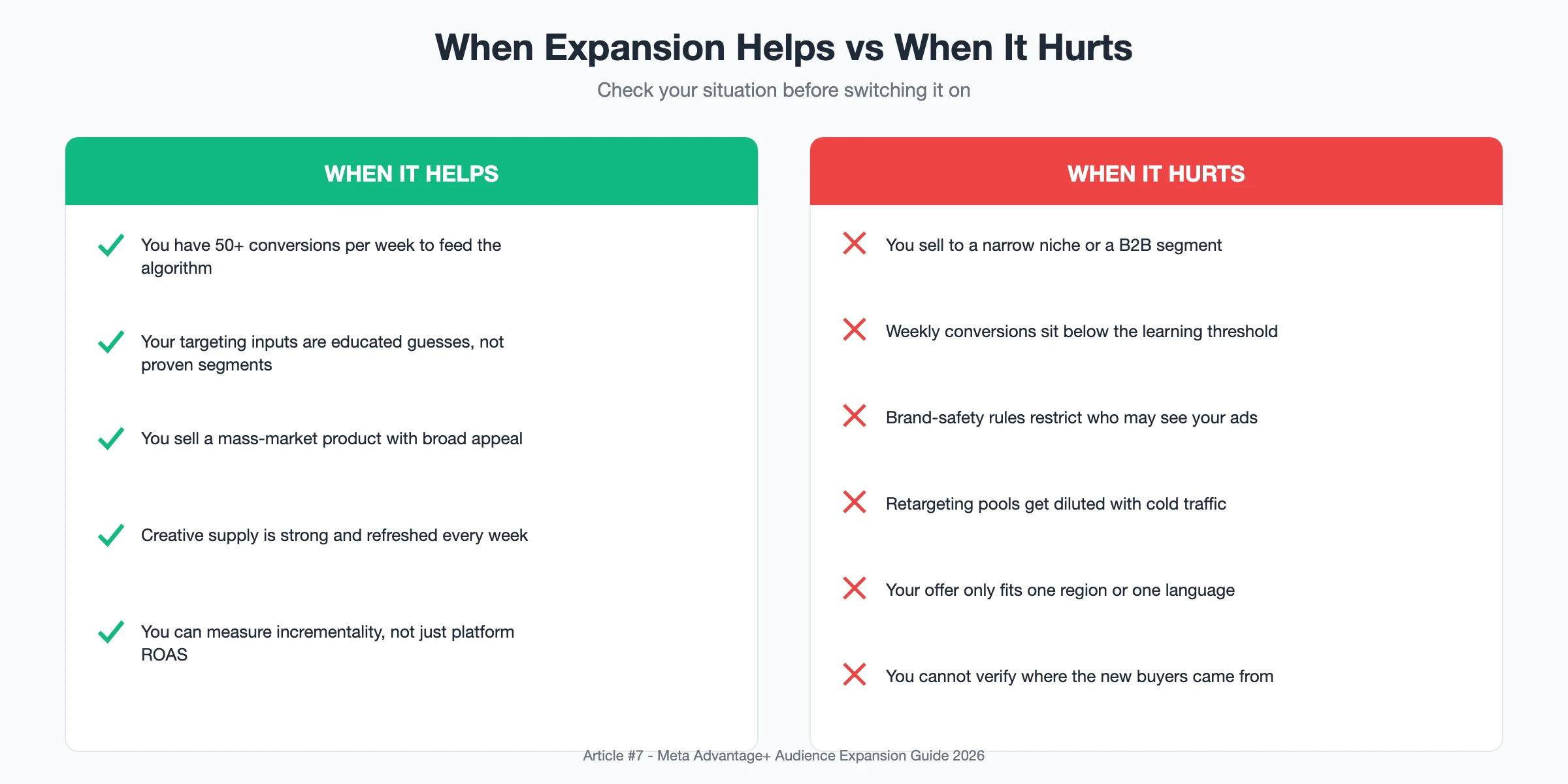
You have 50+ weekly conversions for reliable signal collection. The algorithm needs consistent data to learn which audience characteristics predict conversion. Below this threshold, results become noisy and unpredictable.
Your product has broad appeal. Cleaning products, basic apparel, kitchen gadgets—these categories work across diverse demographics. Advantage+ can find converters outside your initial assumptions because many different people actually buy them.
You're scaling an already-winning campaign. Once you've identified winning creatives and offers through manual testing, Advantage+ audience helps expand reach without reinventing the wheel.
You accept automated optimization as primary strategy. If you prefer setting parameters and letting algorithms handle execution, Advantage+ aligns with this philosophy. You trade control for convenience.
Manual audience management is consuming disproportionate time. If you're spending more time tweaking audiences than developing creative or analyzing performance, automation may free up capacity for higher-value activities.
If most of these apply, Advantage+ audience deserves serious consideration. If not, manual or hybrid approaches may serve you better.
When Advantage+ Audience Hurts
You need precise audience segmentation. Selling specialized B2B software to CTOs? Targeting luxury watches to high-net-worth individuals? These niches require specificity that Advantage+ dilutes through its expansion logic.
Your product category is narrow. Niche hobbies, specialized equipment, region-specific products—these have limited addressable markets. Advantage+ may spread budget too thin searching for converts in irrelevant segments.
You're testing new markets with unknown audience behaviors. When entering unfamiliar geographies or demographics, you need manual control to understand what works before handing optimization to algorithms.
Brand safety is critical. If certain demographics, interests, or behaviors would damage brand perception if associated with your ads, Advantage+ offers insufficient guardrails.
You have small budgets needing maximum efficiency. With $500/month budgets, every dollar counts. Advantage+ experimentation phase may waste spend that manual targeting could allocate more precisely.
You need to test specific hypotheses. Want to know if men respond better to feature-focused messaging? Advantage+ won't let you isolate that variable cleanly.
A Hybrid Approach: Start Automated, Refine Manually
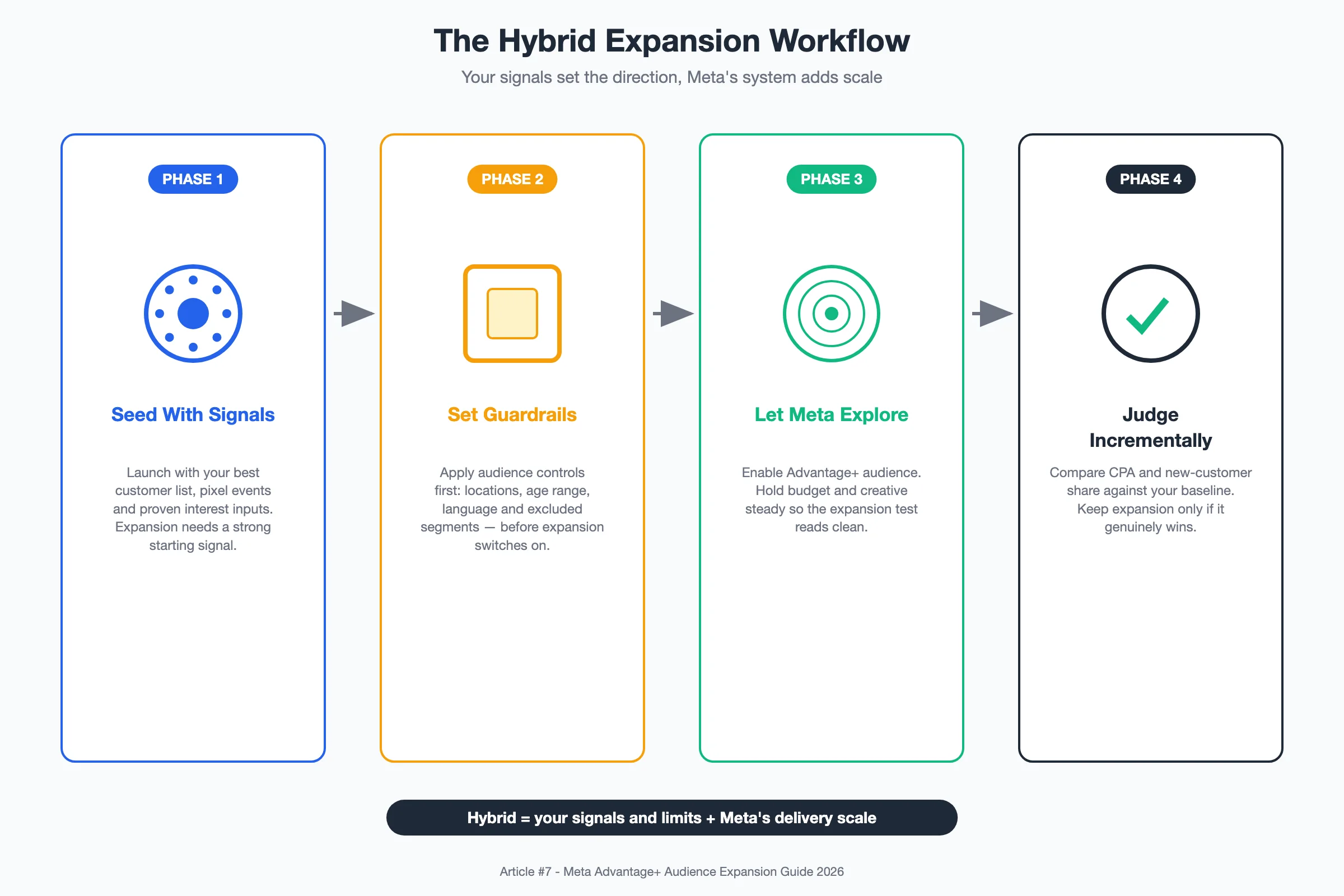
Instead of binary choice (fully automated vs fully manual), try this workflow:
Phase 1: Launch with Advantage+ Audience
Run campaigns with Advantage+ enabled for 2-4 weeks, allowing the algorithm to collect data. Set reasonable budget caps and monitor overall performance metrics (ROAS, CPA, conversion volume).
Success criteria: Consistent performance meeting or exceeding targets, stable CPA over time, no unexpected audience spikes (e.g., sudden surge from unusual geography).
Phase 2: Request Detailed Breakdowns
After sufficient data collection, request audience-level performance reports. Look for:
- Which demographic layers perform best (age ranges, genders)
- Which interest categories drive conversions
- Unexpected high-performing segments worth exploring
- Low-performing segments draining budget
Phase 3: Pause and Refine
Based on insights from Phase 2:
Option A: Keep Advantage+ but adjust inputs. If certain demographics consistently underperform, exclude them from your base targeting while keeping automation active for other layers.
Option B: Switch to manual targeting for specific segments. Create separate campaigns targeting high-performing segments discovered in Phase 2, using manual controls for maximum precision.
Option C: Run parallel tests. Maintain Advantage+ campaign alongside manually-targeted campaigns comparing performance side-by-side.
Phase 4: Reallocate Budget
Shift budget toward approaches delivering best incremental value. If manual campaigns outperform Advantage+ by 30%+ on ROAS, consider reducing Advantage+ allocation. If Advantage+ scales efficiently while manual hits limits, lean heavier into automation.
This hybrid approach acknowledges that neither pure automation nor pure manual control is universally optimal. Your answer depends on product type, budget size, and organizational capabilities.
Diagnostic Checklist for Audience Performance
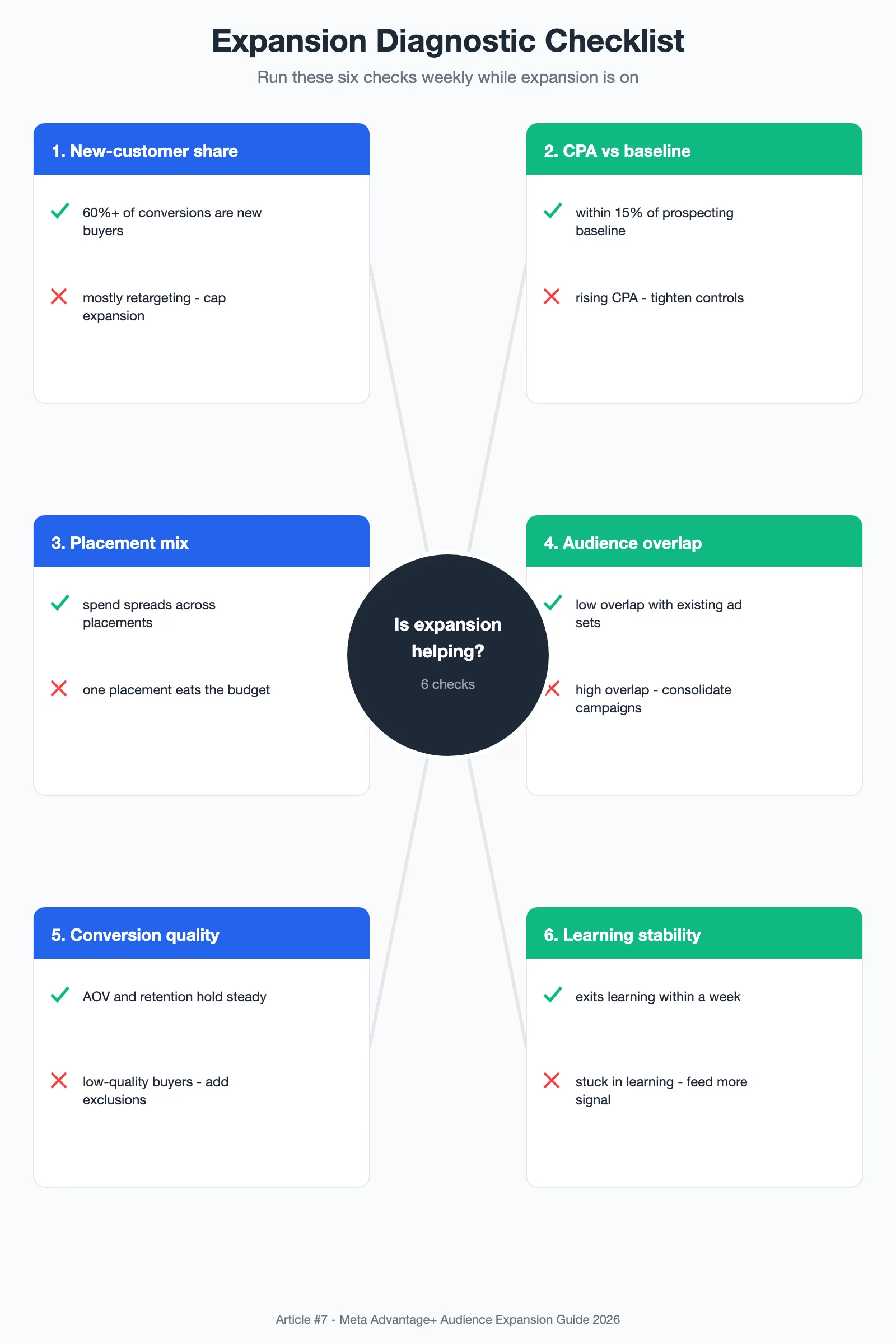
When evaluating whether Advantage+ audience is working for you, ask:
Conversion rate trends: Is CVR stable, improving, or declining over time? Declining CVR with stable spend suggests audience quality degradation.
Frequency patterns: Is ad frequency increasing too rapidly (>3 per week)? Rapid frequency growth indicates audience saturation, suggesting Advantage+ has exhausted relevant users in your niche.
CPM trajectory: Are CPMs rising faster than benchmark expectations? Rising CPMs combined with Advantage+ may indicate competition for expanded audience pools.
Audience layer performance: Can you identify which demographic or interest layers drive conversions? If all layers perform similarly, Advantage+ is working. If one layer dominates, manual targeting might capture that value more efficiently.
Attribution window effects: Are you seeing delayed conversions (7-day click) that 1-day click metrics miss? Advantage+ may be driving top-of-funnel awareness that converts later; ensure measurement windows capture full picture.
Creative-audience interaction: Are certain creatives performing disproportionately well with specific audience layers? This suggests creative-audience fit matters more than pure audience targeting; invest in creative testing rather than audience tweaking.
Testing Framework: Advantage+ vs Manual
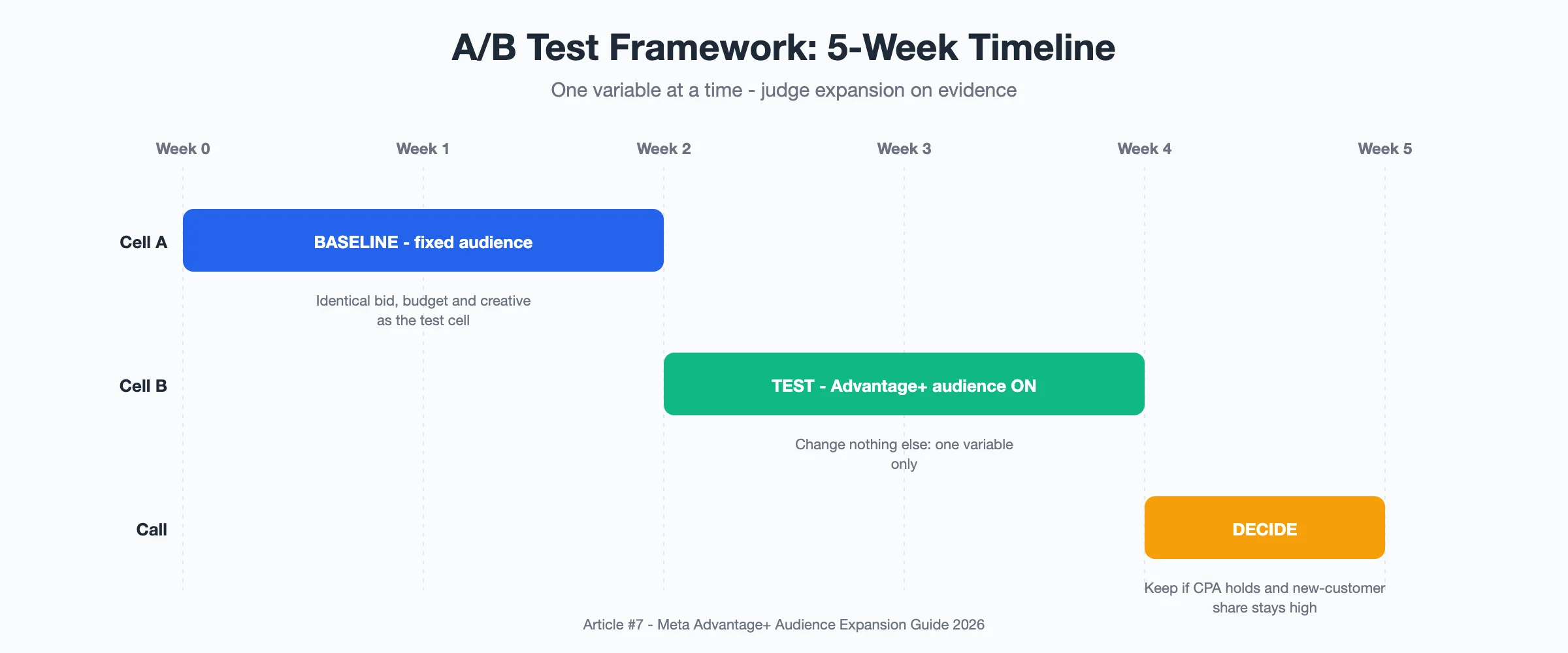
Before committing to one approach long-term, run structured comparison tests:
Week 1-2: Parallel runs
- Campaign A: Advantage+ audience, $500/day budget, winning creative
- Campaign B: Manual audience (your best-performing segments), $500/day budget, identical creative
- Measure: ROAS, CPA, conversion volume, audience composition
Week 3-4: Analyze and adjust
- If Advantage+ outperforms by >20%: Scale Advantage+, reduce manual testing
- If manual outperforms by >20%: Shift budget to manual, use Advantage+ only for incremental reach
- If performance within 10%: Choose based on operational efficiency (which requires less ongoing management?)
Week 5+: Optimize allocation
- Based on test results, establish baseline allocation (e.g., 70% Advantage+, 30% manual)
- Monitor monthly, adjusting based on performance shifts
- Document learnings for future campaign launches
The Real Question: Do You Need Control or Results?
Here's where merchants make strategic errors: They optimize for control when they should be optimizing for results.
Manual audience targeting gives you control—you decide exactly who sees your ads. But control doesn't guarantee better outcomes. Sometimes the algorithm finds converters you never considered.
Advantage+ audience gives you results—at least initially. It scales efficiently, finds new converters, reduces management overhead. But results may come at the cost of transparency and predictability.
Your answer depends on:
- How much do you value knowing exactly who sees your ads versus just getting conversions?
- Can you tolerate some opacity in exchange for scale and efficiency?
- Does your team have capacity for manual audience management, or would automation free up resources?
- Is your product broad enough for Advantage+ to work, or niche enough to require precision?
There's no universal answer. But there is a calculable one for your specific situation. Test both approaches, measure incrementality, and let data—not ideology—guide your decision.
Sources:
- Get-Ryze Meta AI Agents 2026 – Automation implementation guidance
- Adamigo Interest-Based Audiences – Manual targeting fundamentals
- Stackmatix Advantage+ Guide – Platform mechanics and recommendations
- Overseas CMCM A+ Creative Analysis – Automation insights applicable to audience expansion