How I Plan a Quarter of Creative Tests (and Actually Stick to It)
A quarter of creative tests falls apart without a roadmap. Here is the planning system, tiered portfolio, and weekly cadence I use to actually stick to it.
Practitioner playbook — a composite field guide written from the perspective of a Growth Marketing Lead. Figures are illustrative, not verified client results.
A few years ago I treated creative testing like whack-a-mole. Someone had an idea in the morning standup, we shipped it by Thursday, and by the following month I could not tell you what we had actually learned or what we were still trying to find out. The problem was never a shortage of ideas — it was the total absence of a plan that survived contact with a busy week. Every good intention got crowded out by the next fire.
What changed everything was deciding a quarter in advance what I would test, budgeting time and spend for it, and then defending that plan as if it were a media budget. This is the system I run now: a quarterly roadmap, a tiered portfolio so I am never only optimizing or only exploring, a weekly cadence board, a scoring matrix for what earns a slot, and a review loop that forces last quarter's learnings into this quarter's plan. The numbers here are the shapes of how I think, not verified outcomes for any brand.
Write the Quarter Down Before You Spend a Dollar
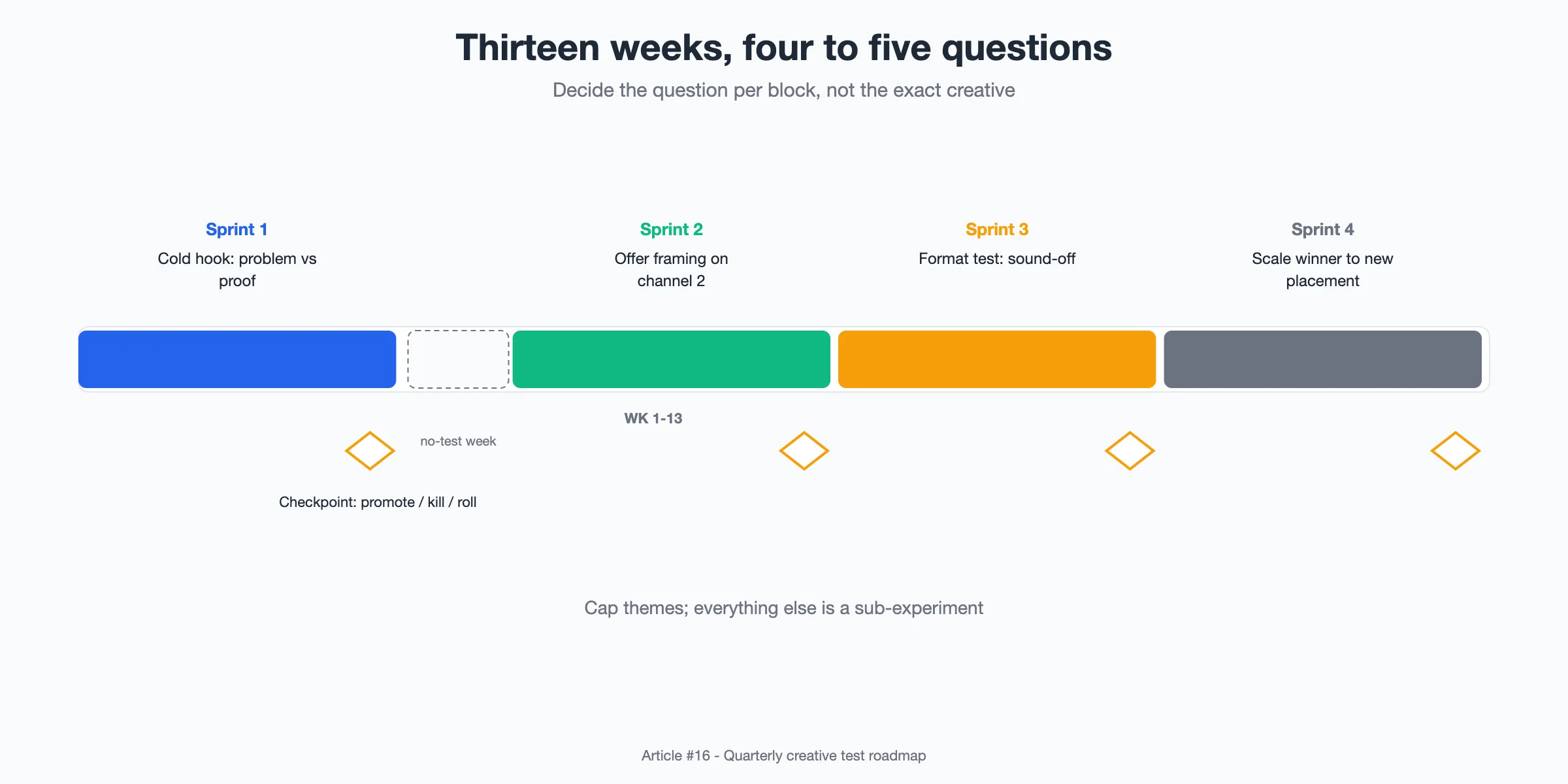
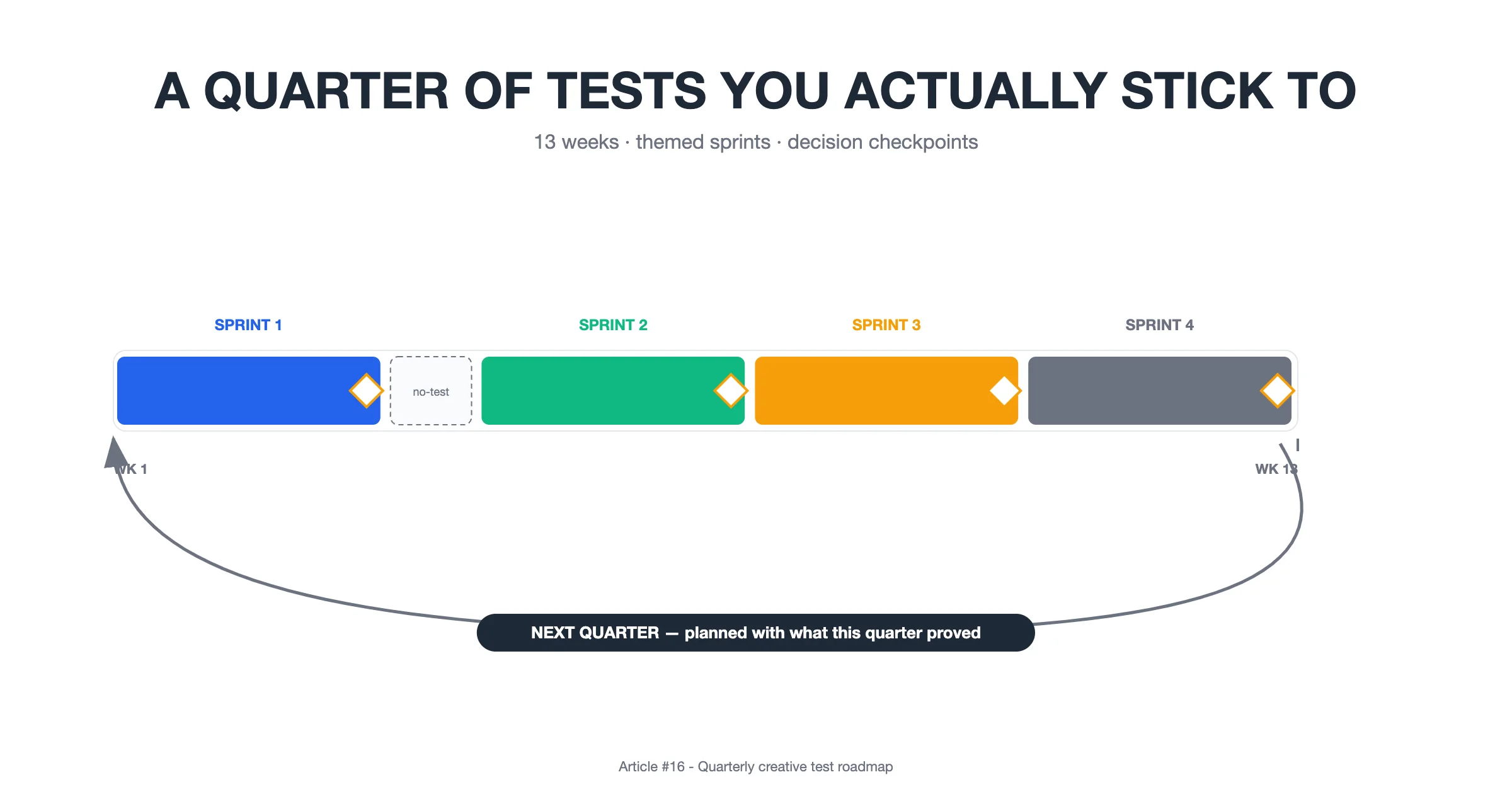
I start every quarter by writing a one-page roadmap that maps roughly thirteen weeks into themed sprints rather than an open backlog. Each sprint has one dominant question: "does the problem-first hook beat the proof-first hook for cold traffic?", or "which offer framing holds up on a second channel?" I do not decide the exact creative in week one; I decide the question each block of weeks is allowed to answer. That constraint is what keeps the quarter coherent when the inbox gets loud.
The roadmap has three fixed features that make it stickable. First, there are pre-scheduled no-test weeks after big spend pushes, so the team is not permanently underwater and the plan survives real capacity limits. Second, each sprint has an explicit decision checkpoint where I either promote a winner, kill a dead angle, or roll the question forward one week — with a default action if nobody decides, because indecision is the quiet killer of roadmaps. Third, I cap the total number of themes per quarter. For a lean setup I usually hold it to four or five big questions and let everything else be a sub-experiment inside them. Fewer, sharper questions beat a long list I will never close.
Split the Portfolio Into Explore, Optimize, and Scale
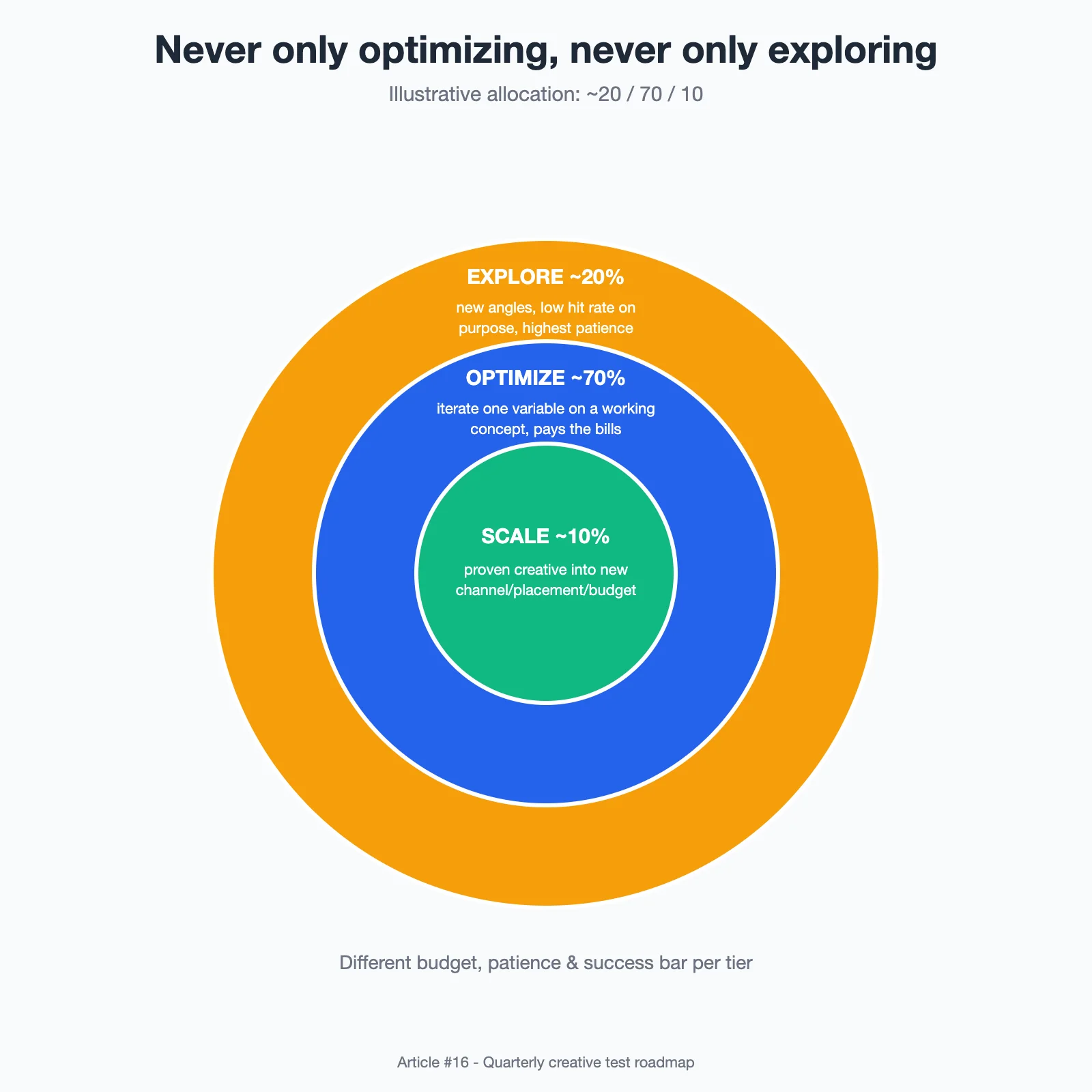
The failure mode of most test plans is that they drift entirely into safe optimization, or they swing to the other pole and become endless novelty. I prevent both by splitting the quarter's slots into three tiers and holding to an illustrative allocation: roughly two-tenths exploration, seven-tenths optimization, and one-tenth scale. If a quarter goes by with no exploration, I have a brittle account; if it goes by with no scale, I have a science project.
Exploration is where I try genuinely new angles — unfamiliar hooks, formats, or audiences — accepting a low hit rate on purpose, because that is what finding a new winner costs. Optimization is the engine room: iterating an already-working concept one variable at a time, the part of testing that pays most of the bills. Scale is deliberately narrow — taking a proven creative and pushing it into a new channel, placement, or budget band to see if it holds. The tiers get different budgets, different patience, and different definitions of success, and I never judge an exploration test by the same bar I hold a scale test to. Naming the tiers out loud is the single most useful thing in this whole system, because it stops me from panicking when a scrappy experiment looks "unprofitable" in week one — that was the deal I made with myself when I allocated the two-tenths.
Run It on a Weekly Cadence Board, Not Memory
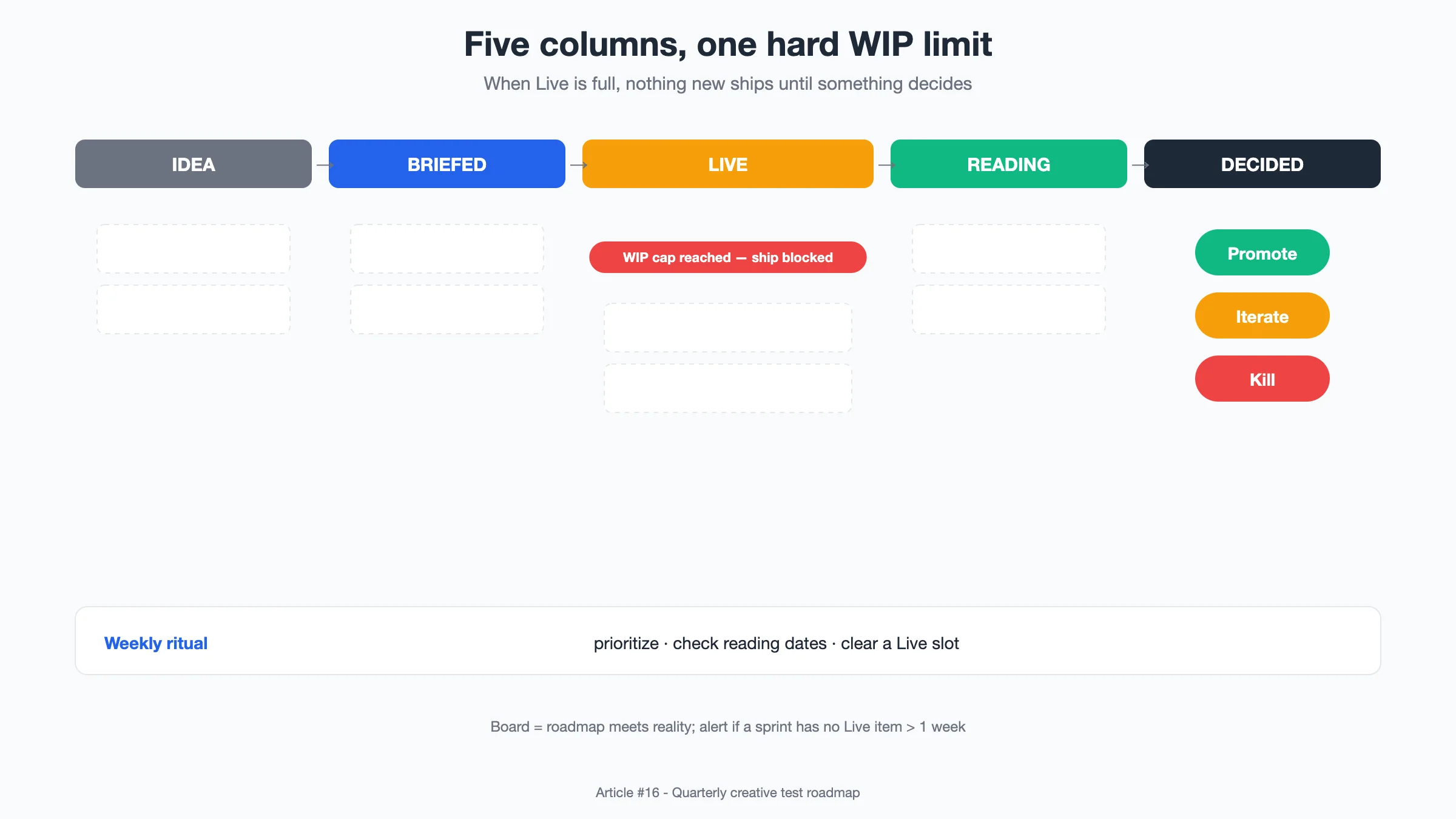
A quarterly plan only survives if it decomposes into a weekly rhythm with a hard work-in-progress limit. My board has five columns — Idea, Briefed, Live, Reading, Decided — and the rule that actually keeps me honest is a WIP cap on the Live column. When Live is full, nothing new ships until something gets a decision. That single constraint is what forces closure instead of a graveyard of ads nobody ever looked at.
Each week has the same shape: a short prioritization pass to pull one or two items forward, a check on anything that hit its pre-set reading date, and a decision step that clears a Live slot. Nothing on the board gets to sit past its defined test window without an explicit reason logged against it. The board is where the roadmap and reality meet. The quarterly sprints tell me what questions matter; the weekly board tells me what is actually running and what is stuck. When the two disagree for more than a week — when a sprint's question is never represented in Live — that is my early warning that the roadmap was fantasy, and I rewrite it rather than pretend.
Score the Backlog So the Best Test Wins the Slot
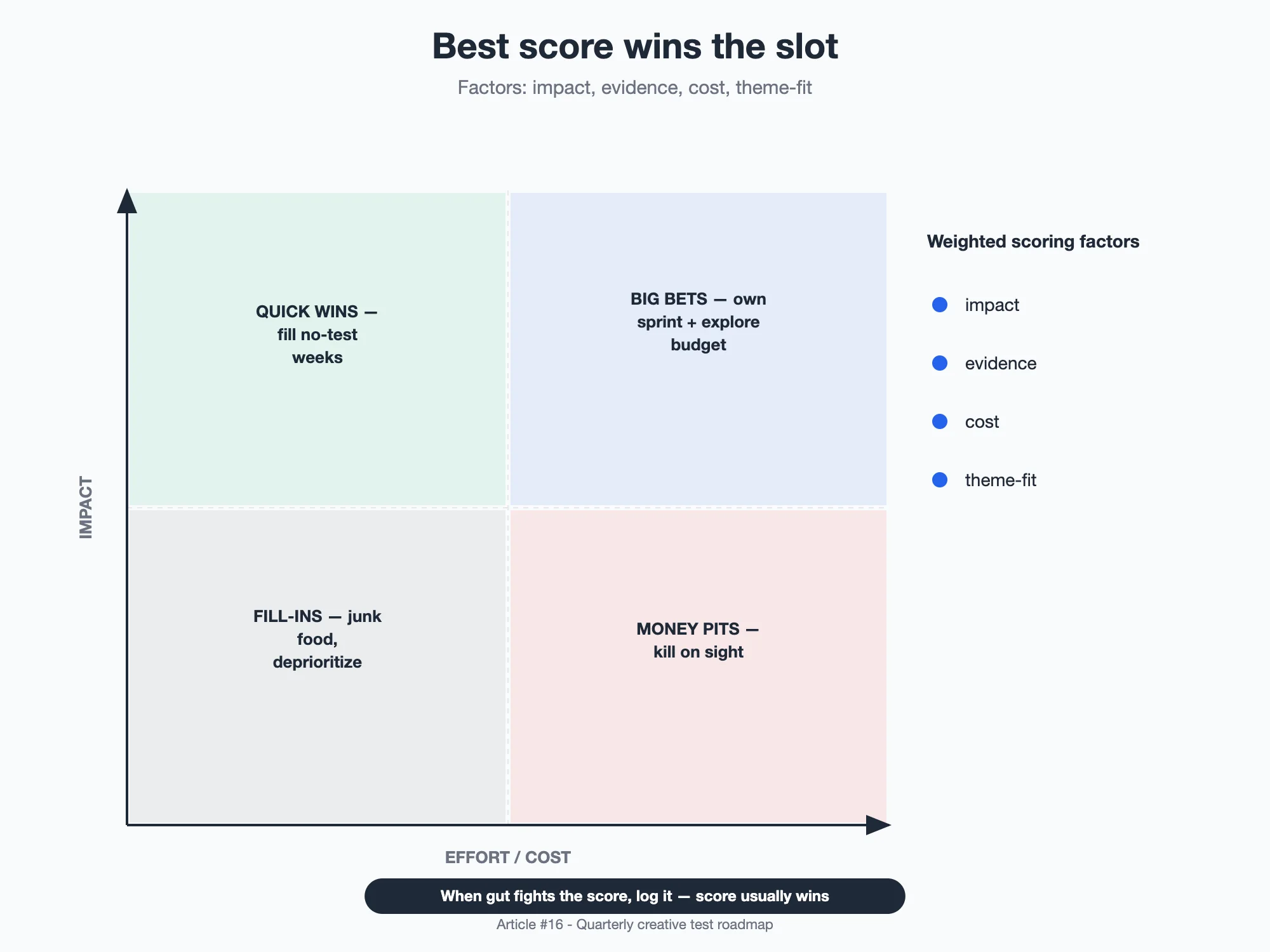
Every idea does not deserve a slot, and the only way I stopped letting the loudest voice win is a simple scoring matrix. I rate each candidate on a handful of weighted factors — likely impact, evidence behind the hypothesis, cost to produce, and how much it advances the quarter's current theme. The output is a priority score that decides order, and I treat that score as a conversation with myself, not a governor: when a gut call fights the score, I log why, and most of the time the score wins.
To keep it honest I plot impact against effort in a simple quadrant. Quick wins (high impact, low effort) fill my no-test-week gaps and keep momentum. Big bets (high impact, high effort) get their own sprint slot and my exploration budget. Fill-ins (low impact, low effort) are tempting junk food and get deprioritized hard. Money pits (low impact, high effort) I kill outright on sight, usually someone's favorite idea from three weeks ago. The quadrant stops me from confusing "fun to make" with "worth learning." It also makes saying no cheap and fast, which matters more than people expect: a testing operation that cannot say no quickly spends its whole quarter on two beloved projects and learns nothing durable from either.
Close the Loop So the Quarter Rehearses the Next One
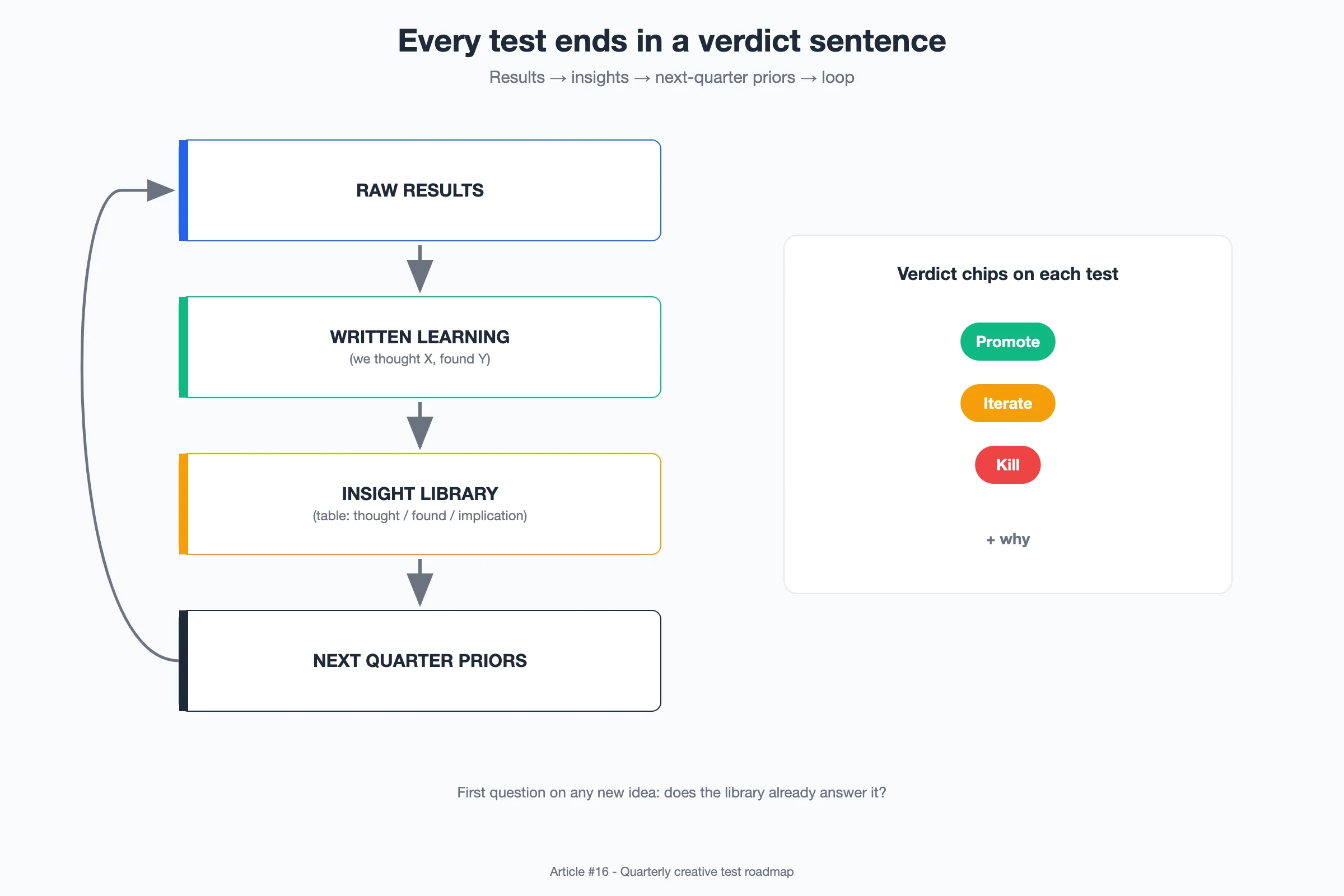
The step everyone skips is the one that compounds: a real retro. At each sprint checkpoint and again at quarter end, I run a short loop — turn raw results into written learnings, feed those into an insight library, and let that library set the priors for next quarter's roadmap. Every test has to end in one of three recorded verdicts: promote, iterate, or kill, each with one line on why. No test exits the board without a verdict sentence, because an unrecorded learning is a learning I will repeat by accident in two months.
The insight library is deliberately boring: a running table of "we thought X, we found Y, next implication Z." Its whole job is to turn one-off results into reusable priors. When someone proposes a test next quarter, my first question is whether the library already answers it. That one habit kills maybe a third of the backlog before it burns any budget, and it is the reason a planned quarter beats a reactive one four times a year, every year. I care less about any single test's outcome than about whether the operation got smarter since last quarter. If the answer is no, the roadmap itself — not the creatives — is what I need to change next.
The Real Question: Are You Planning Tests or Just Scheduling Work?
The uncomfortable thing I had to admit is that a full board is not the same as a plan. It is entirely possible to fill thirteen weeks with neatly scheduled tests that answer no question anyone needed answered, and to feel productive doing it. The roadmap earns its keep only if it forces me to name what I do not yet know and to spend the quarter reducing exactly that uncertainty. A calendar is easy; the discipline is deciding in advance which unknowns are worth paying for, and having the nerve to kill the rest. That is the part no template does for you.
Sources:
- Quarterly planning and OKR framework guides — general framing for setting questions in advance and defending a plan against weekly noise.
- Kanban and work-in-progress limit references — background on how WIP caps force closure and keep a cadence honest.
- Prioritization matrix literature (impact vs effort / ICE-style scoring) — orientation on ranking a backlog and saying no cheaply.
- Agile retrospective and knowledge-base primers — how written learnings turn one-off results into reusable priors.
Disclosure: This piece is written from a practitioner's perspective to share a working method. It is not a customer testimonial, and any numbers are illustrative examples, not guaranteed outcomes.