From One Product Shoot to 30 Variants: My Batch Workflow
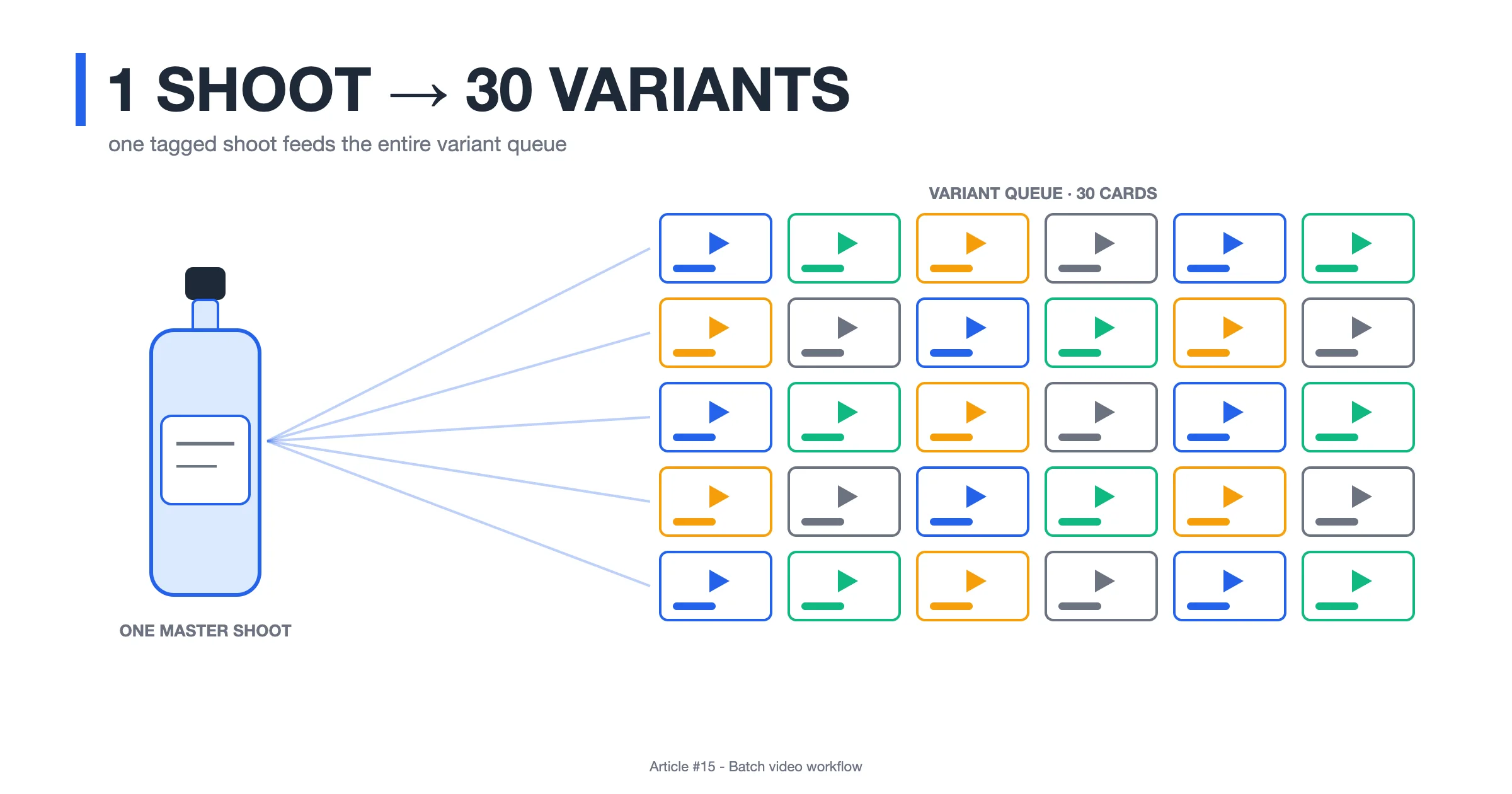
I stopped reshooting every ad. One well-planned product shoot now feeds a batch workflow that turns a single master asset set into dozens of testable variants.
Practitioner playbook — a composite field guide written from the perspective of a Skincare Brand Founder. Figures are illustrative, not verified client results.
When I launched my skincare label, I shot every ad the old way: book a studio, brief a creator, reshoot for each new hook, and pray the spend was worth it. My small team could realistically produce three or four finished videos a week, and half of those died in the first two seconds of the feed. The bottleneck was never ideas. It was the physical act of capturing usable footage over and over.
The shift came when I stopped treating the shoot as the unit of content and started treating it as the unit of raw material. One well-planned product shoot now feeds a batch workflow that spins out dozens of testable variants across hooks, lengths, aspect ratios, and copy. This is the exact process I run, with the naming rules and the schedule that keep thirty files from turning into chaos. Every number below is an illustrative shape of how I think, not a verified result from any brand.
Start With the Shoot, Not the Script: Capturing a Master Asset Set
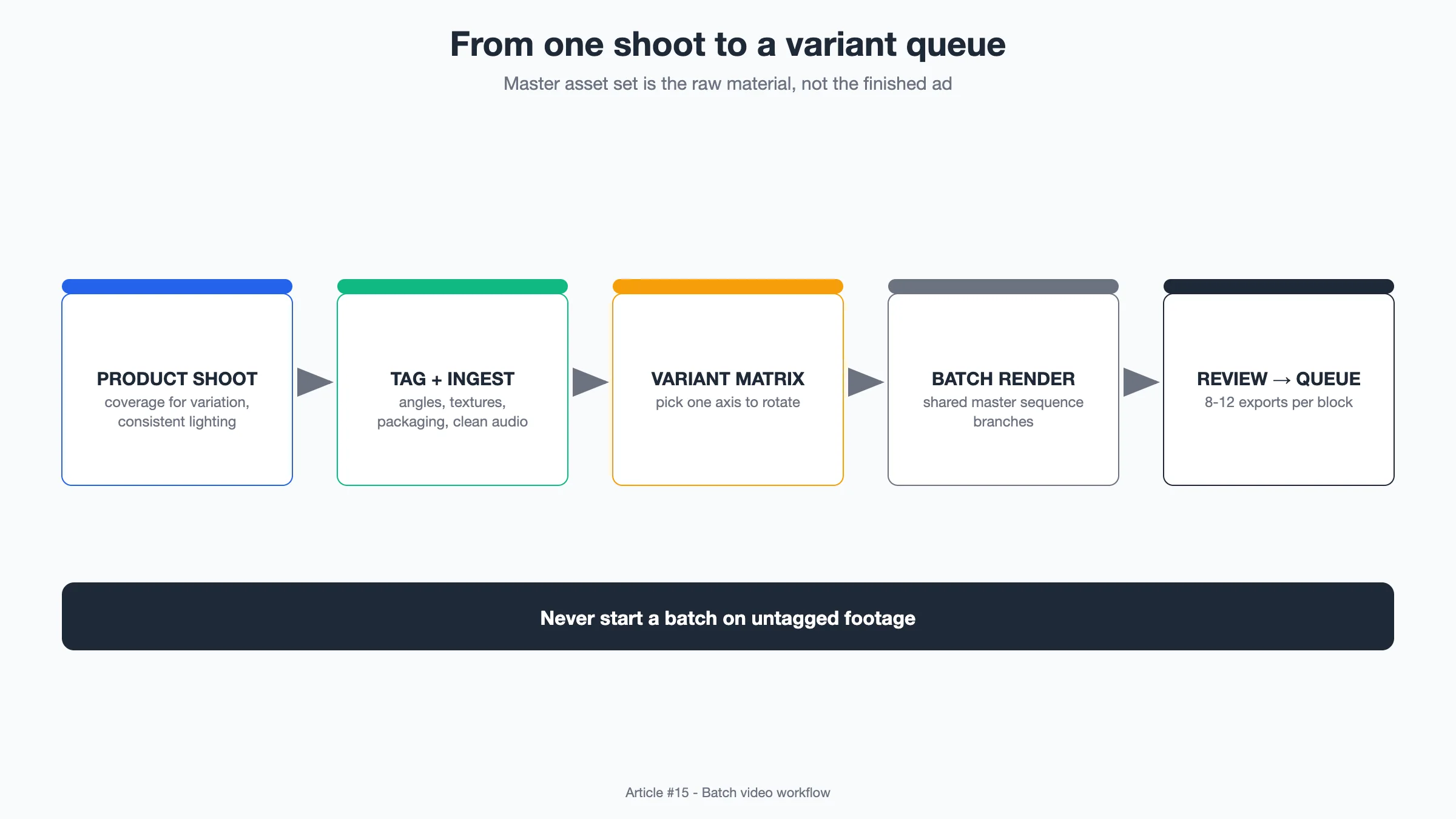
Most batch workflows fail before the first render because the source footage was never designed to be sliced. I now plan the shoot around coverage for variation, not around a single finished spot. Before we roll camera, I write a shot list where every product appears in a plain neutral background, in use on skin, in hand, and in a texture close-up. Those four angles are the atoms I recombine later.
The rule I hold myself to: capture more than any one edit needs. If a hero shot is eight seconds, I roll thirty. Static tripod angles and slow handheld passes both go in the basket, because a slow push-in reads premium while a locked-off wide reads informative, and I want to test which my audience prefers. Lighting stays consistent across the whole session so variants feel like one family. I also record clean, unedited audio and pull B-roll of packaging, caps, and droppers as separate clips — nothing baked together. That separation is what makes batching possible downstream. I keep a running shot log during the shoot itself, marking which angles came out clean, because memory is unreliable by the time I'm tagging that evening. The master asset set is now the deliverable I care about on shoot day, not any single finished clip, and that one mindset change is what unlocked the rest of the workflow.
The Variant Matrix: Hooks x Length x Aspect x Copy
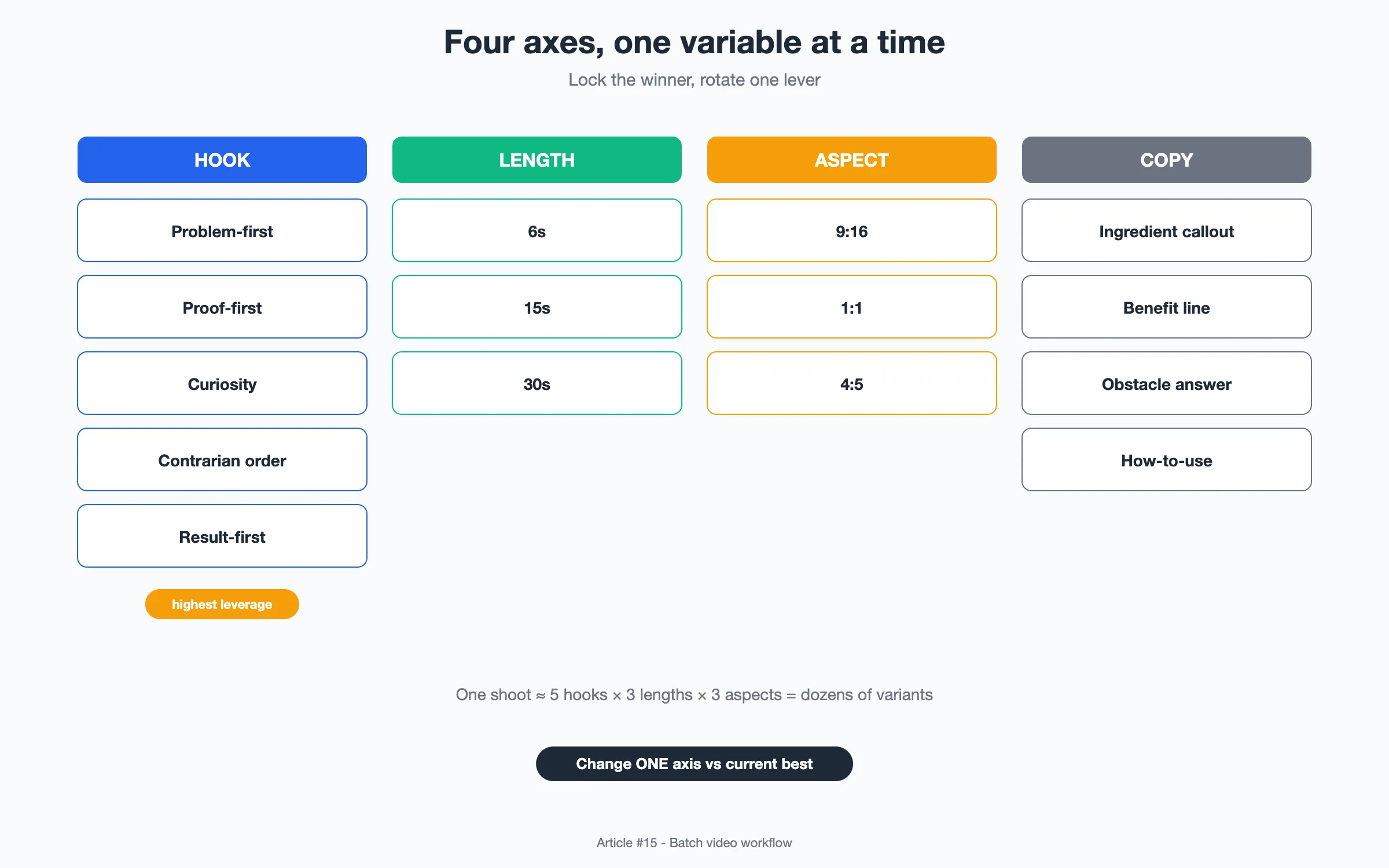
Once I have a master asset set, I stop guessing which versions to build and fill in a matrix instead. My four axes are hook, length, aspect ratio, and copy overlay. A single product shoot gives me enough raw footage to populate roughly five hooks x three lengths x three aspect ratios, which is already a combinatorial grid of dozens of legitimate variants — the "thirty" in my title is a normal Tuesday, not a stretch.
Here is how I keep the grid honest. I never test all four axes at once, because then I cannot tell which change did the work. I lock one axis to the current best performer and rotate a single variable. For skincare specifically, the hook is my highest-leverage axis, so most of my batch energy goes there: a problem-first open ("your barrier is why you're dry"), a proof-first open (texture close-up with an ingredient callout), and a curiosity open ("the order you apply serums is probably wrong"). Length, aspect, and copy are the secondary levers I bend around a winning hook.
Naming and Asset Management So 30 Files Stay Findable
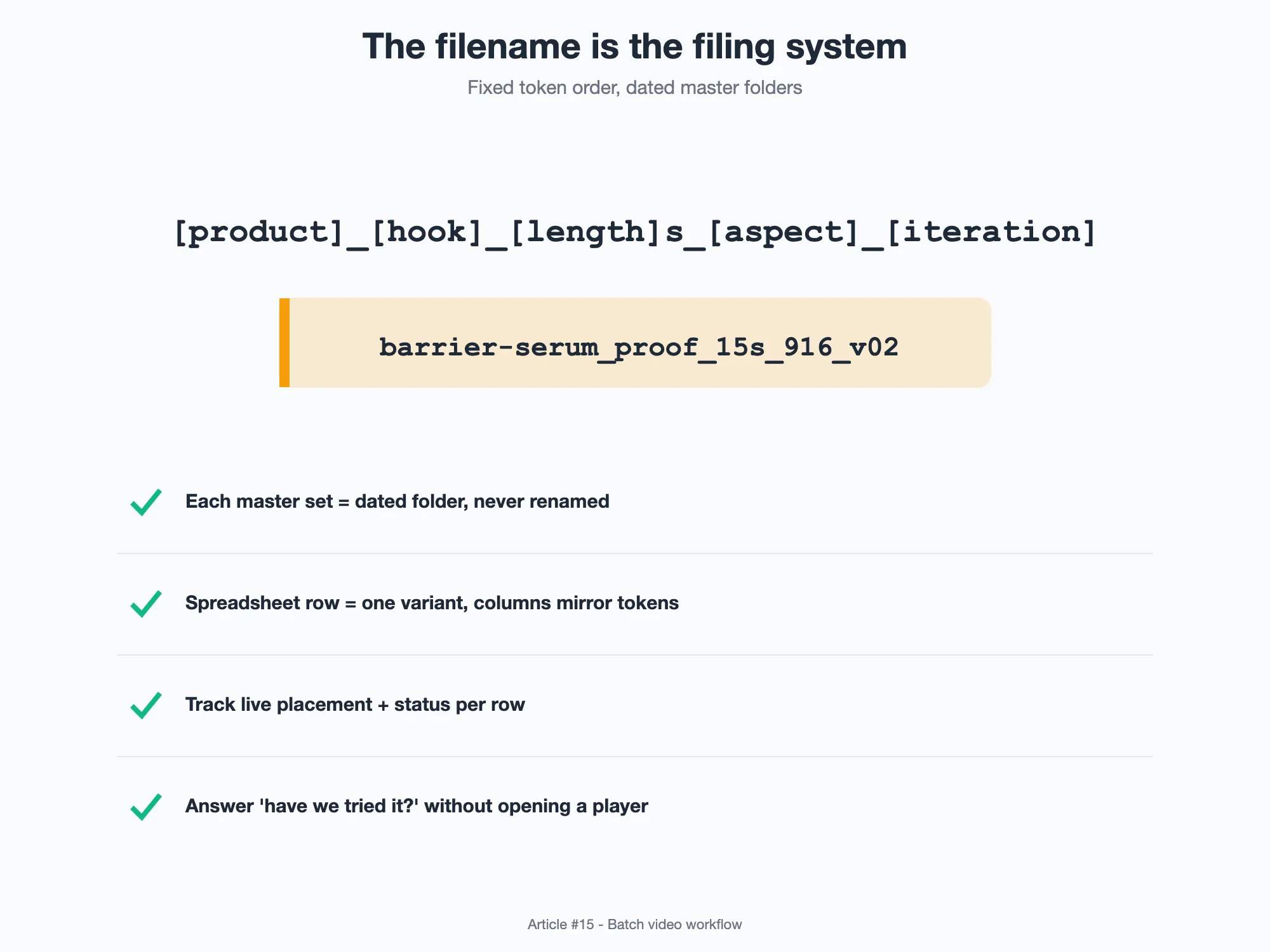
Batching without a naming convention is how you end up with forty files called final_FINAL_v3 and zero confidence about what any of them contain. I run one rigid filename pattern for every export, and I refuse to let anyone on my team deviate from it. The pattern encodes product, hook, length, aspect, and iteration in a fixed order, so a filename alone tells me whether I've already tested that combination.
My template reads: [product]_[hook]_[length]s_[aspect]_[iteration], which produces something like barrier-serum_proof_15s_916_v02. Two habits make this stick. First, every master asset set gets its own dated folder that I never rename after ingest, so re-cuts always point back to the same source. Second, I keep a single living spreadsheet where each row is one variant and columns mirror the filename tokens — hook, length, aspect, plus where it's live and its status. When someone asks "have we tried the curiosity hook at six seconds in square?", I answer in five seconds without opening a video player.
Batch Rendering: What One Render Session Actually Buys You
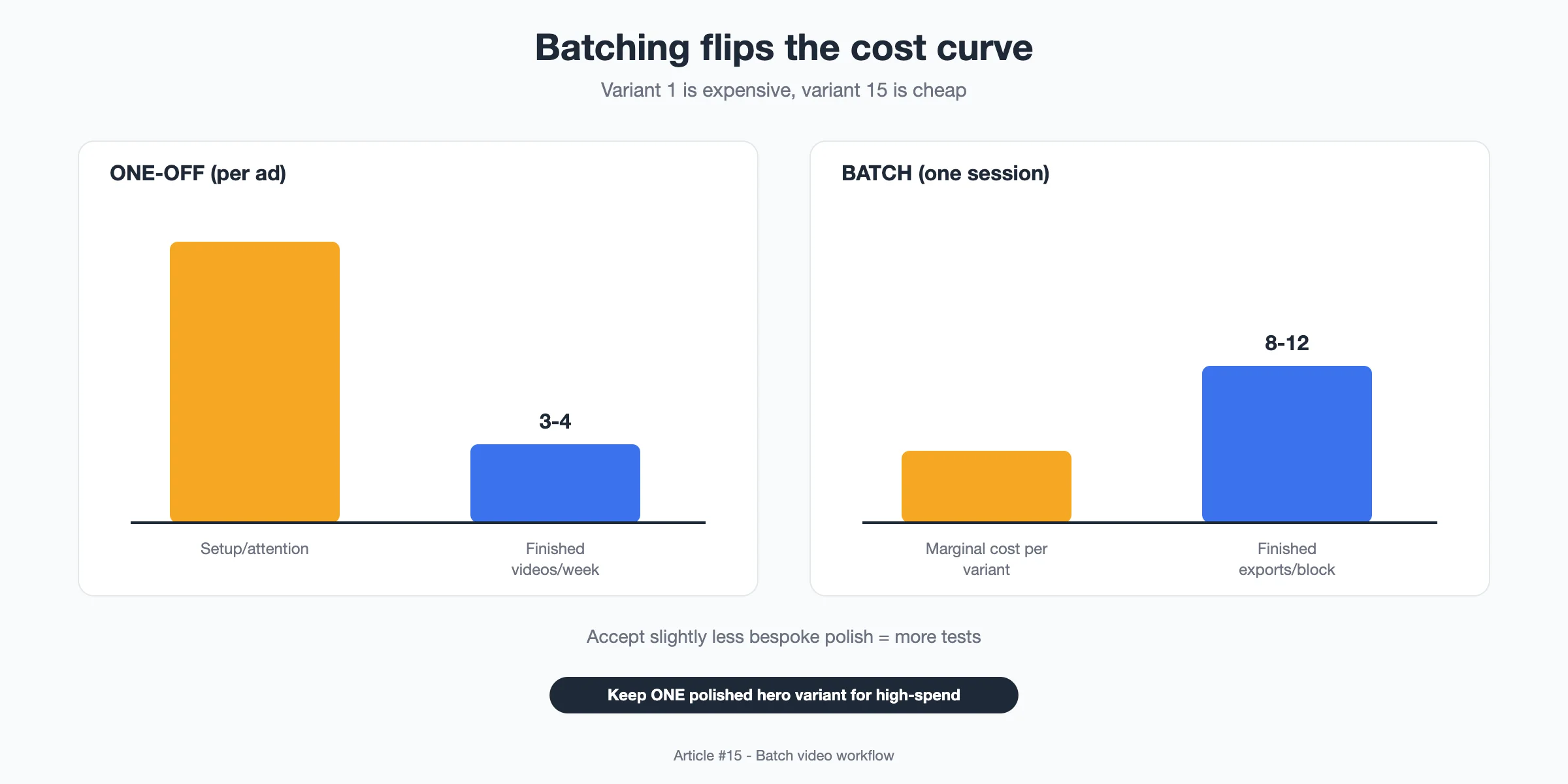
I front-load the expensive thinking and back-load the cheap rendering. Editing one spot start-to-finish on demand costs me a full day of attention and interrupts everything else. Batching flips that: I spend one focused block assembling variant skeletons in the AI video editor, letting a shared master sequence branch into many versions that differ only on the axes I chose in the matrix. The marginal cost of variant number fifteen, once the base exists, is a fraction of variant one.
Concretely, a single render block now clears a queue I used to spread over a week. I measure the trade honestly: batching means each individual cut gets a little less bespoke polish, and I accept that, because breadth of testing wins more often than a perfect single edit in a lean skincare budget. I keep one "hero" variant that does get the extra polish for high-spend placements, and let the batch carry the volume of tests. The right number of variants per block, for my team, sits around eight to twelve finished exports — enough to fill a week's tests, few enough that I can actually review every one before it spends money.
My Weekly Batch Schedule (Gantt, Not Vibes)
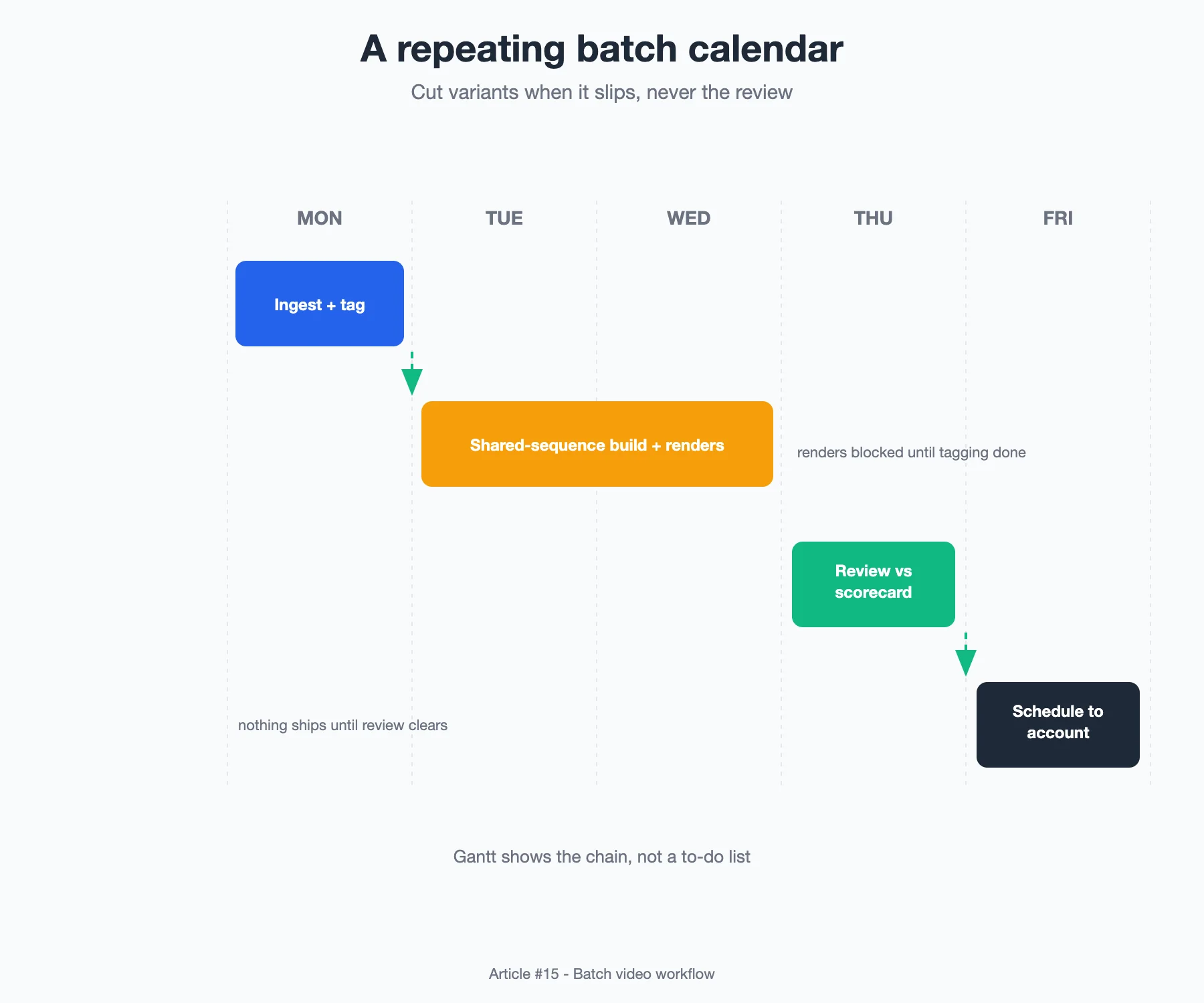
Batching collapses if it lives only in my head, so it now sits on a repeating weekly calendar. Ingest and tagging happen first — I never let raw footage age more than a day before it's labeled, or the asset library rots. Mid-week is my single render block, and I protect it like a meeting. Review and QA come after, always before anything ships, because a batch lets you publish a mistake thirty times over.
My default rhythm looks like this: Monday ingest and matrix planning, Tuesday and Wednesday shared-sequence build plus variant renders, Thursday review against the scorecard of what I already tested, Friday scheduling into the account. The reason the schedule is a gantt and not a to-do list is dependency: renders can't start until the master set is tagged, and nothing ships until review clears. Visualizing that chain is what keeps me from starting a batch on Monday afternoon, realizing the footage isn't tagged, and losing the whole day. When the calendar slips, I cut the number of variants, never the review step — a smaller clean batch beats a bigger unreviewed one every time.
The Real Question: Are You Batch-Producing or Just Mass-Producing?
The uncomfortable line I had to draw for myself is between batching and flooding. Batching means one intentional shoot and one matrix producing a manageable spread of variants I can genuinely learn from, each tied to a specific hypothesis. Mass-producing means turning the same footage into noise because volume felt productive. Thirty variants only help if I read what they tell me and let that change the next matrix. The workflow gives me more shots on goal; it does not give me the judgment to know which goals to aim at. That part — deciding what the next batch should even test — is still mine to do, and it's the part that actually compounds. If you take one thing from my process, take this: build the pipeline so production stops being the bottleneck, then spend the freed-up attention on the hypotheses worth testing. Volume is cheap now; a good question is not.
Sources:
- Creative operations and content-batching guides — general framing for treating production as repeatable pipelines rather than one-off jobs.
- Short-form video and feed-ad format references — orientation on aspect ratios, hook lengths, and sound-off viewing conventions.
- Digital asset management (DAM) naming best-practice articles — background on filename tokens and versioning discipline for large media libraries.
- A/B and multivariate testing primers — how to isolate one variable at a time so test readouts stay interpretable.
Disclosure: This piece is written from a practitioner's perspective to share a working method. It is not a customer testimonial, and any numbers are illustrative examples, not guaranteed outcomes.