The First-3-Seconds Hook Formula I Use Before I Brief Any AI Video Ad
I never brief an AI video ad until the first three seconds are solved. Here is the hook formula, hook wheel, and scorecard I run every time.
Practitioner playbook — a composite field guide written from the perspective of a UGC Creator & Scriptwriter. Figures are illustrative, not verified client results.
I write hooks for a living, and the tools have changed under me. Half the product ads I now script never get filmed with a human at all; they get briefed into an AI video generator. That shift broke one of my old habits: when I shot on a phone, the first three seconds were somewhat forced by reality, because I only had so much footage. With AI, I can generate infinite middle and end, so the temptation is to over-produce the back half and treat the opening as an afterthought. That is exactly backwards. If the first three seconds fail, nothing after them exists to the viewer.
So I made a hard rule: I do not brief a single frame of an AI video ad until the opening is solved on paper. The rest of the ad is the easy part. What follows is the formula I use to build those three seconds, the five hook archetypes I rotate so nothing goes stale, how I match a hook to a product category, the beat flow that carries the hook into a full script, and the scorecard a hook has to pass before it earns a prompt.
What Actually Happens in the First Three Seconds
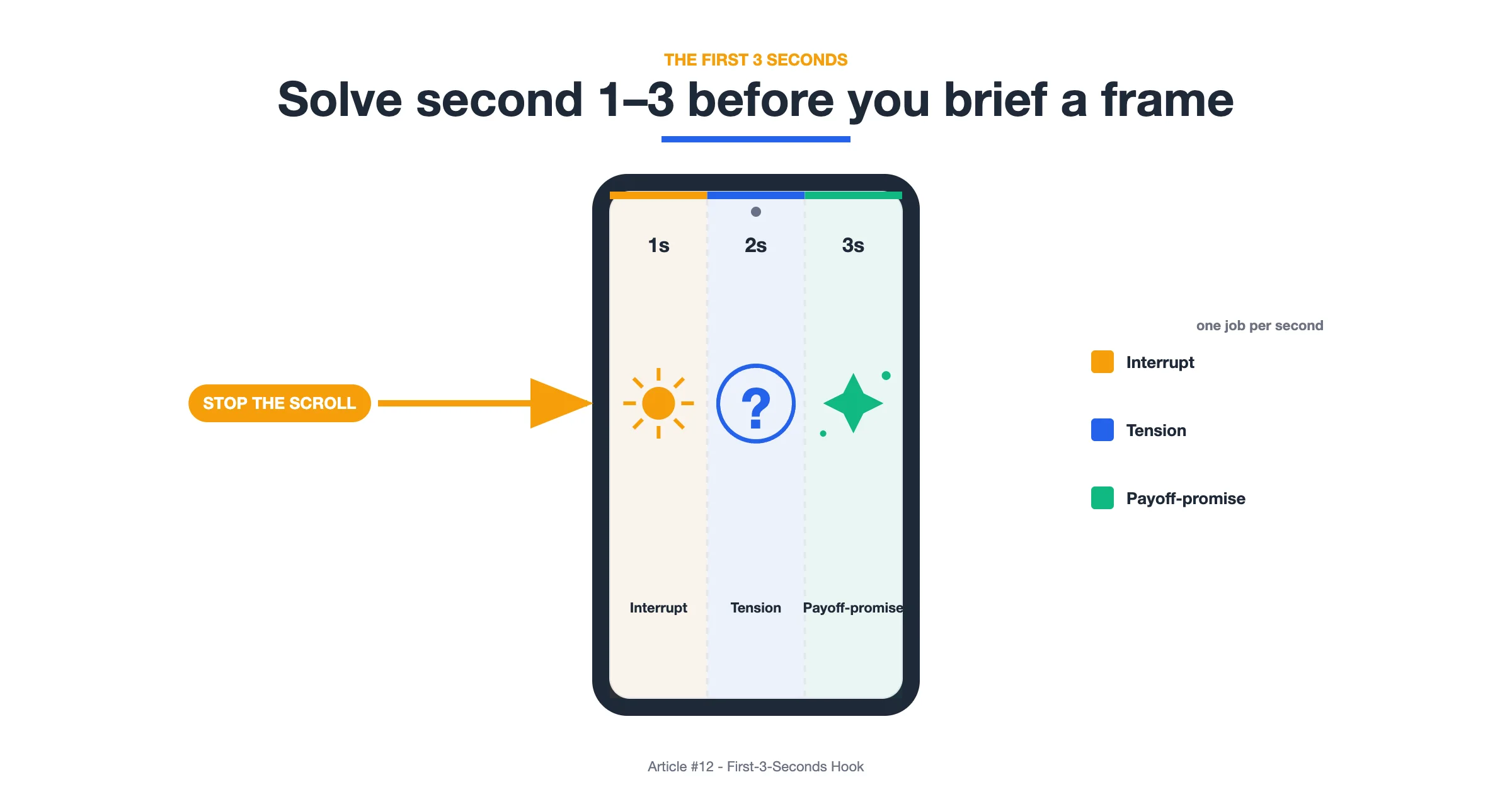
A viewer makes a keep-or-scroll decision before they have consciously registered your product. I treat the opening as three distinct one-second jobs, and if any one of them is missing, the hook leaks attention. I diagram the anatomy every time so I stop writing "pretty intros" that do no work.
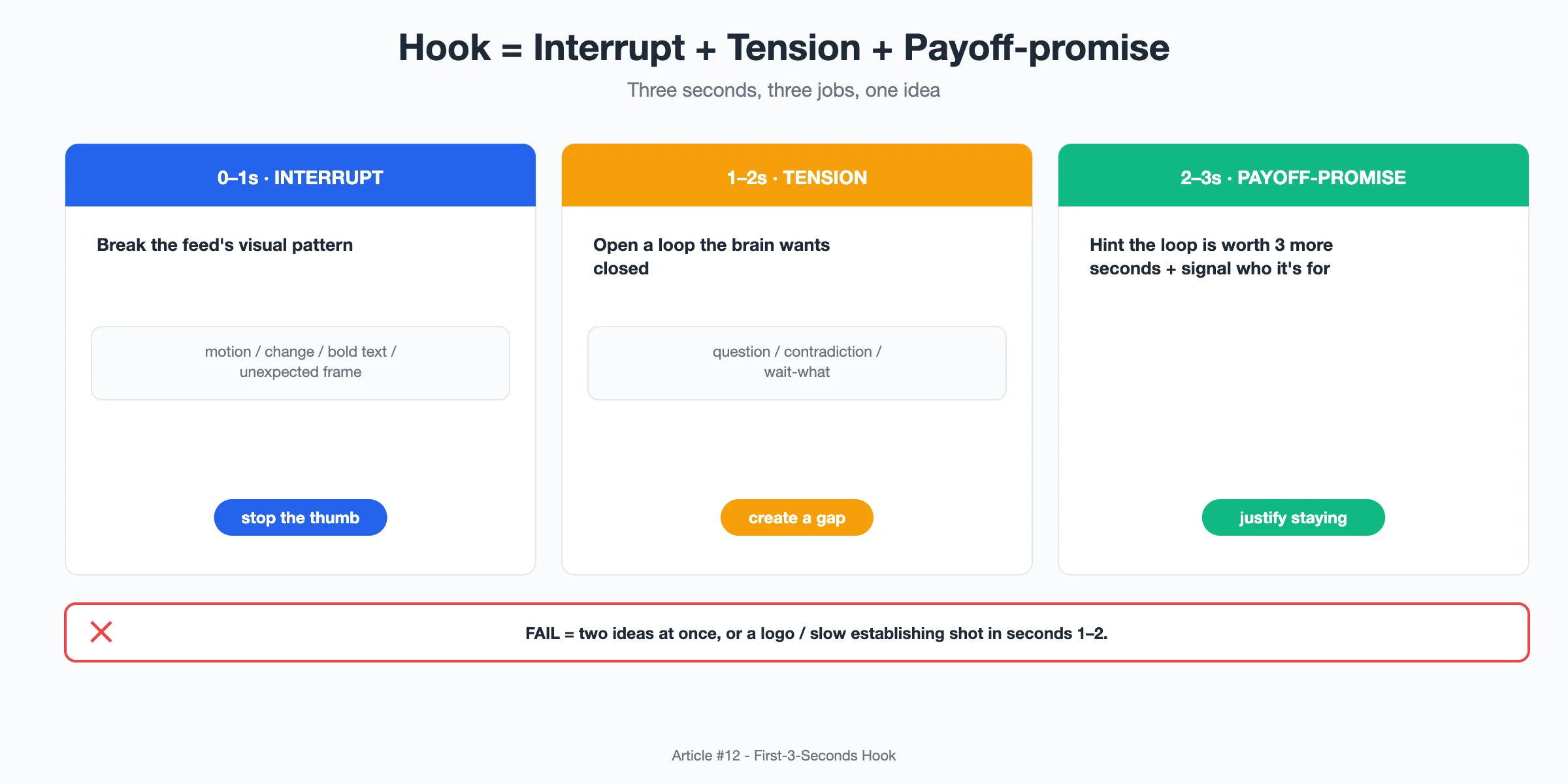
My working formula, which I keep simple enough to recite: Hook = Interrupt + Tension + Payoff-promise.
- Second 1, the Interrupt: something on screen must break the feed's visual pattern. A motion, a change, a face, a bold text block, an unexpected frame. The job is only to stop the thumb.
- Second 2, the Tension: open a loop the brain wants closed. A question, a contradiction, a "wait, what?" The job is to create a small gap of curiosity or discomfort.
- Second 3, the Payoff-promise: hint that closing the loop is worth three more seconds, and quietly signal who it is for. The job is to justify staying.
Three seconds, three jobs, one idea. The number one reason a hook fails for me is that the creator tried to do two ideas at once, or spent seconds one and two on a logo or a slow establishing shot. I ban both.
The Five Hook Types I Rotate Through
Once the anatomy is fixed, I vary the kind of tension I open with, because a single hook style saturates fast on any account. I keep five archetypes on a wheel and force myself to draft at least three of them before I brief anything, so I am choosing, not defaulting.
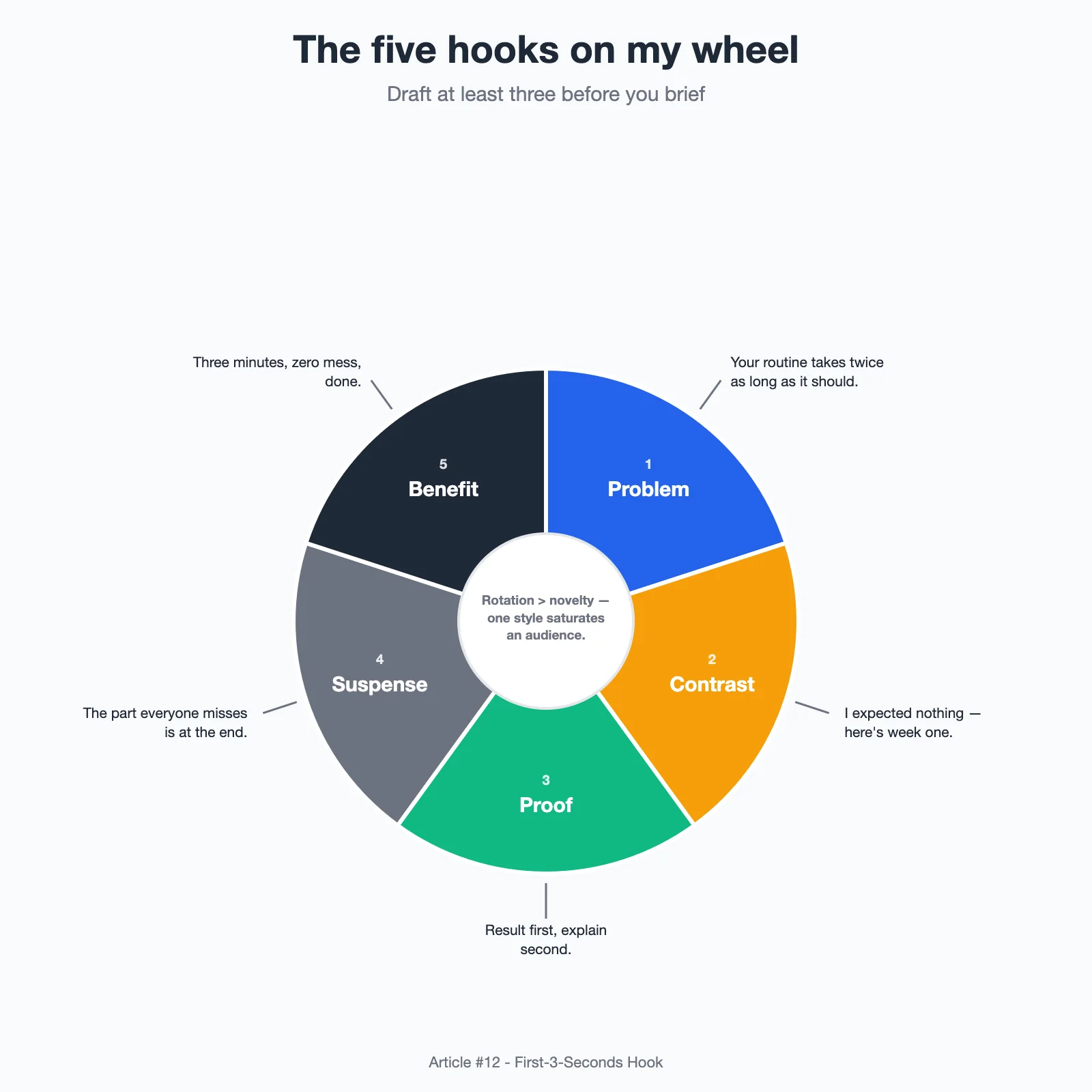
The five I use, each with the first line I actually brief:
- Problem hook: name the frustration out loud. "Your [routine] takes twice as long as it should."
- Contrast hook: a before/after or expectation/reality split. "I expected nothing. Here is week one."
- Proof hook: lead with visible evidence. Close-up of the result first, explain second.
- Suspense hook: withhold the payoff deliberately. "The part everyone misses is at the end."
- Benefit hook: front-load the win. "Three minutes, zero mess, done."
Rotation matters more than novelty. An account that only ever runs proof hooks trains its audience to tune them out, so I schedule variety the way a media buyer schedules creative refresh.
Matching the Hook to the Product Category
A hook that crushes for a gadget can fall flat for a serum, because the reason people buy differs by category. I keep a rough matrix in my head so I open with the archetype the category rewards. These are directional tendencies I have learned, not laws, and I always leave myself permission to break the cell when the specific product is unusual.
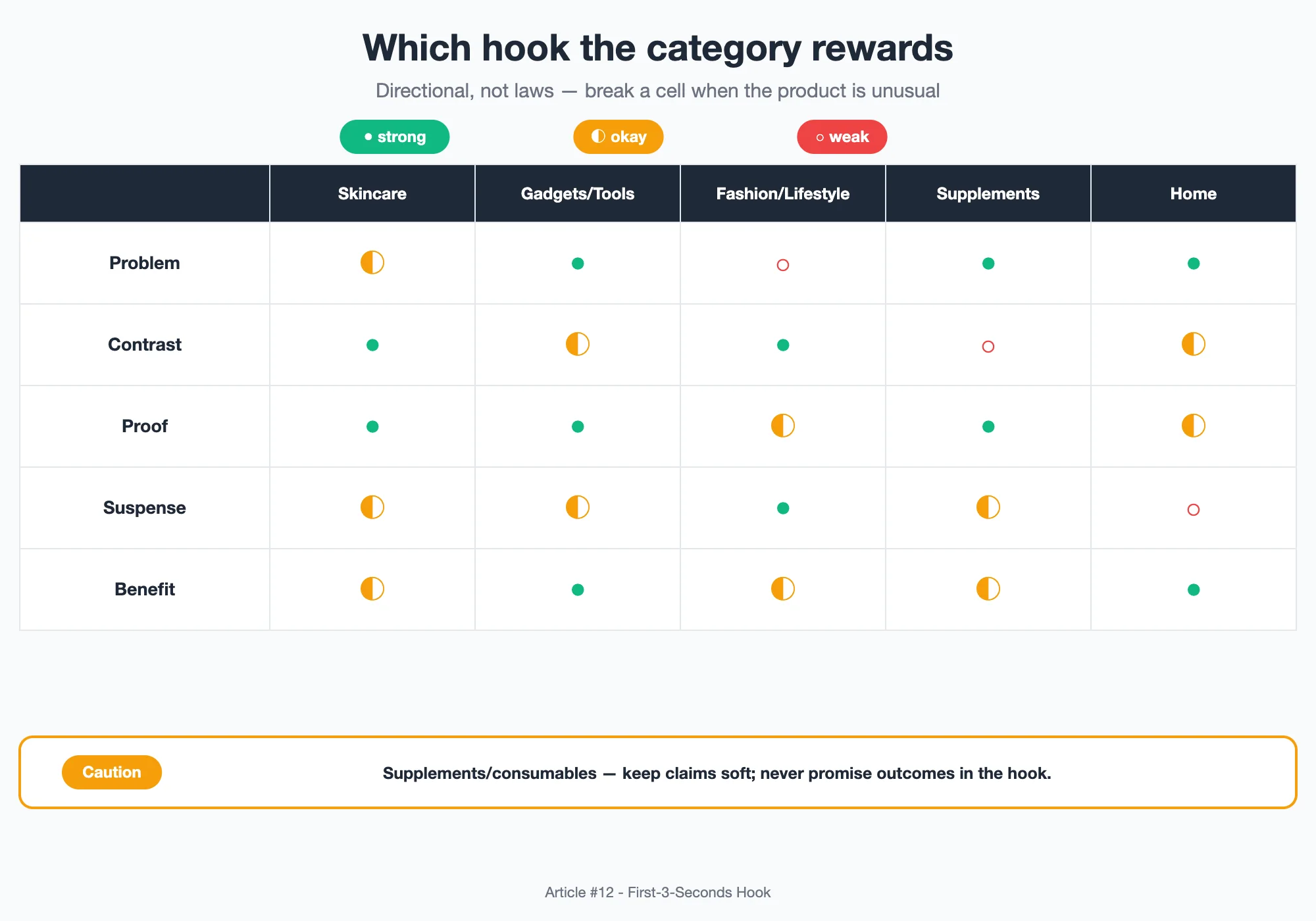
The way I read it: transformation-friendly categories like skincare and fitness lean on Proof and Contrast because the before/after is the whole story. Tool and gadget categories lean on Problem and Benefit because viewers want the friction named and the shortcut promised. Fashion and lifestyle lean on Suspense and Benefit because aspiration and "how does it look on" carry the click. Supplements and consumables lean on Problem and Proof, with a hard caution: I keep claims soft and never promise outcomes in the hook. When I have a category that fights its archetype, that is a brief I flag to the client before I write a word, not a script I polish past the problem.
From Hook to Full Script: My Beat Flow
Solving the opening is necessary, not sufficient. A great three-second hook glued to a meandering middle still loses the purchase. So once the hook passes muster, I hang it on a beat flow that keeps each second earning the next.
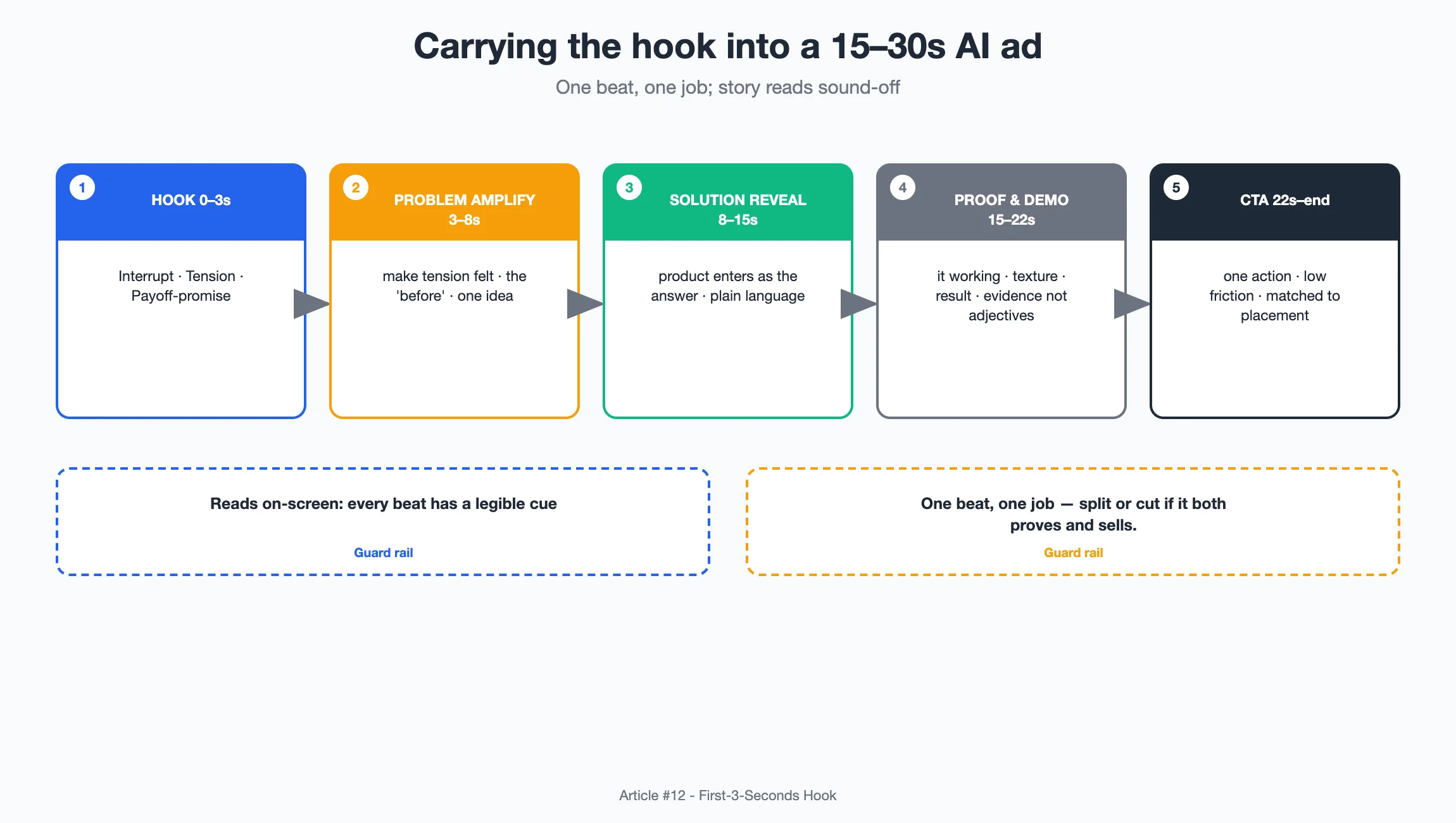
My default skeleton for a 15 to 30 second AI ad:
- 0 to 3s — Hook: Interrupt, Tension, Payoff-promise, exactly as above.
- 3 to 8s — Problem amplify: make the tension felt, show the "before," one clear idea.
- 8 to 15s — Solution reveal: the product enters as the answer; say what it is in plain language.
- 15 to 22s — Proof and demo: show it working, feature in use, texture, result; evidence, not adjectives.
- 22s to end — CTA: one action, low friction, matched to where this runs.
Two rules make this survive a muted feed. First, the story has to read on-screen, so every beat carries a legible text or visual cue, not just voiceover. Second, one beat, one job: the moment a beat tries to both prove and sell, I split it or cut one.
The Hook Scorecard I Run Before I Brief a Single Frame
Before any hook becomes a prompt, it goes through a scorecard. This is the discipline that stopped me briefing ninety mediocre openings a month. Each check is a yes or no with a small score, and a hook has to clear a minimum bar before it earns generation time and budget.
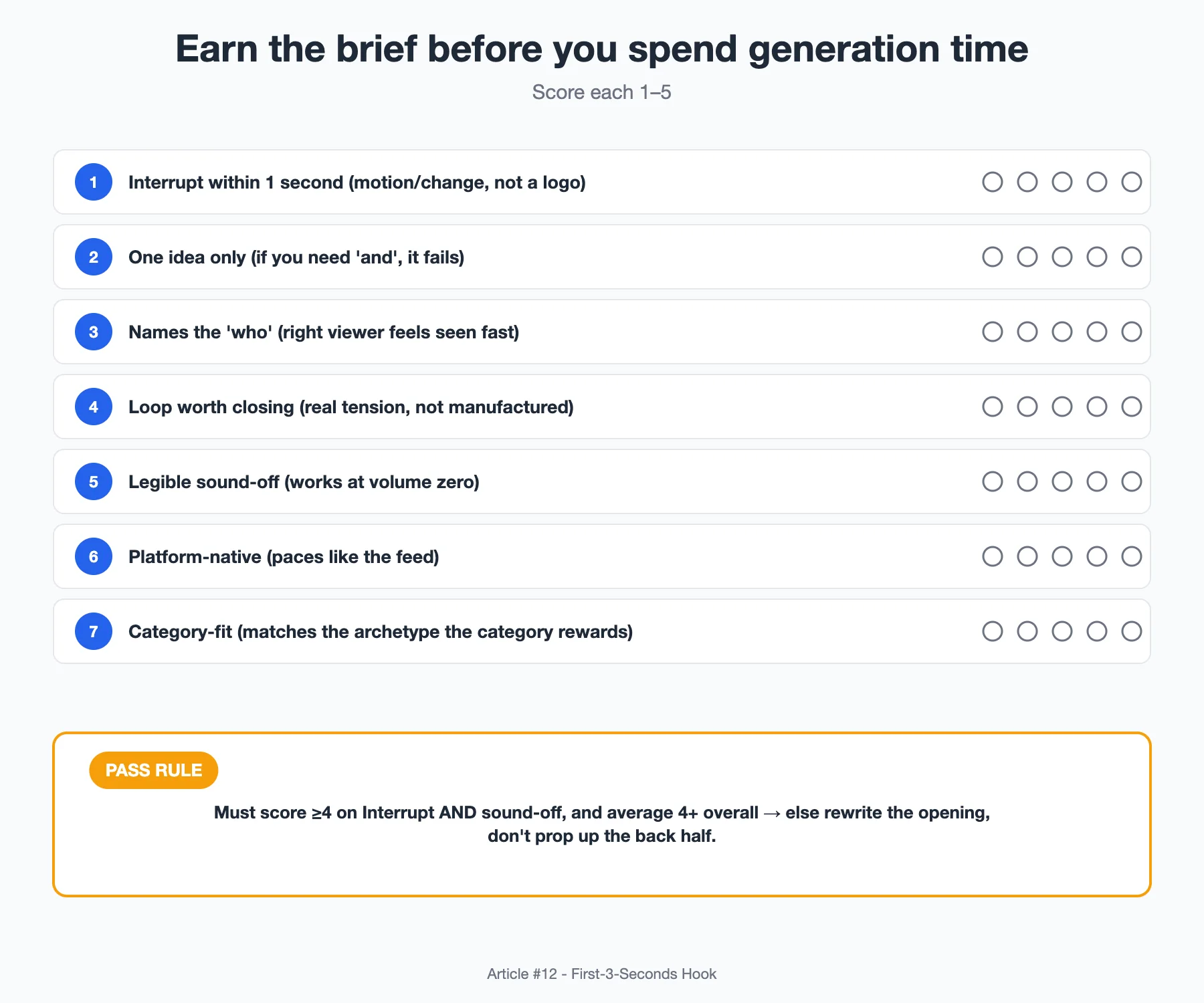
The checks I run, each scored one to five:
- Interrupt within one second? A motion or change, not a static logo.
- One idea only? If I need "and" to describe it, it fails.
- Does it name the "who"? The right viewer should feel seen fast.
- Loop worth closing? Is the tension real, or manufactured.
- Legible sound-off? Works with the volume at zero.
- Platform-native? Looks and paces like the feed, not a TV spot.
- Category-fit? Matches the archetype the category rewards.
My rule: a hook must score at least four on Interrupt and sound-off legibility, and average four-plus across the board, before I brief it. Anything below that, I rewrite the opening rather than prop up the back half, because a beautiful middle on a dead hook is spend I will never see back.
The Real Question: Is It a Hook, or Just a Loud First Frame?
Here is the reframe I hand every new scriptwriter. A hook is not a jump-scare, a caption in all caps, or an explosion in second one. That is a loud first frame, and it buys attention you did not earn and cannot keep. A real hook is a promise about why the next few seconds are worth the viewer's time, packaged so the thumb stops before the conscious mind votes.
So before I brief any AI video ad, I am not asking "what looks coolest at the start." I am asking a stranger's question: "why would someone stop scrolling for this, and is that reason honest?" Solve that in three seconds, and the rest of the ad is just keeping a promise you already made.
Sources:
- TikTok for Business creative best-practices hub — platform guidance on early-frame attention and native, sound-off pacing I cross-check my hooks against.
- Meta Business Help Center on ad creative and hook/thumb-stop metrics — how the ad platforms define the opening-second signals I score.
- Attention-economy research summaries from firms like Nielsen and Lumen — directional support that the first seconds carry outsized weight; context only, not a specific study citation.
- Public video-engagement reports from tools like Wistia and Vidyard — where I sanity-check where drop-off curves typically spike.
Disclosure: This piece is written from a practitioner's perspective to share a working method. It is not a customer testimonial, and any numbers are illustrative examples, not guaranteed outcomes.