AI UGC or Real Creator Content: What Are You Actually Buying?
You're not buying videos. You're buying rights, authenticity, and audience access—and the tradeoffs between them determine which approach makes sense for your brand.
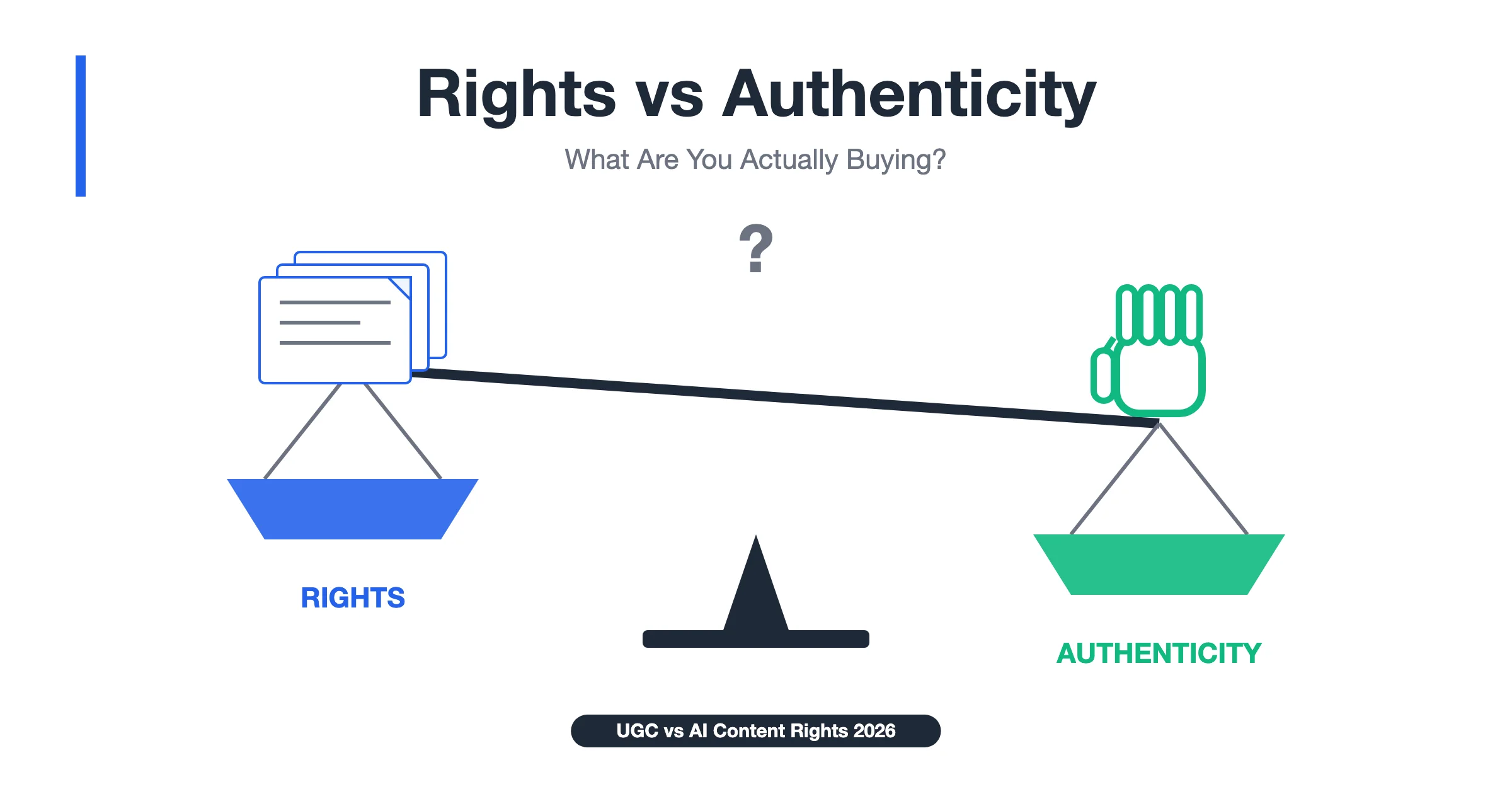
You're not buying videos. You're buying rights, authenticity, and audience access—and the tradeoffs between them determine which approach makes sense for your brand.
Merchants choosing between UGC creator content and AI-generated ads in 2026 face a genuine strategic decision. UGC promises authenticity and creator audience access but comes with rights complexity and variable quality. AI promises scale and consistency but lacks human connection and raises new questions about disclosure requirements.
This article breaks down what you're actually buying in each approach, with a focus on legal rights, quality expectations, and cost per usable asset.
What You're Actually Buying from UGC Creators
When you commission a UGC creator, you're purchasing several things simultaneously:
The video asset: A 15-30 second vertical video featuring your product, typically shot on phone camera with natural lighting and casual presentation.
Usage rights: Permission to run that video as an ad across specified platforms (TikTok, Instagram, Facebook, etc.) for a defined period (often 6-12 months). This is separate from creating the video—you need explicit ad usage rights.
Creator audience access (indirect): When the creator posts your ad to their profile (via Spark Ads or similar), you gain access to their follower base. But this requires their participation and ongoing relationship.
Authenticity signal: Viewers recognize UGC as "real person recommendation" rather than brand-produced content. This signal drives higher engagement rates, especially among younger demographics.
Legal risk transfer: Well-contracted creators warrant that their content doesn't infringe third-party rights (music, imagery, trademarks). This protects you from copyright claims.
The critical piece merchants often underestimate: rights scope. A creator contract might grant you organic social usage but exclude paid advertising. Or it might limit you to TikTok only, preventing Instagram reuse. Always specify:
- Platforms allowed (TikTok, Instagram Reels, Facebook, YouTube Shorts, etc.)
- Duration (6 months, 12 months, perpetual)
- Exclusivity (can creator work with competitors?)
- Modification rights (can you crop, edit, add text?)
- Attribution requirements (must creator tag your brand?)
Without explicit written agreement, you own nothing beyond the raw file. Platform terms of service don't transfer rights between parties.
What You're Actually Buying from AI Video Tools
When you subscribe to an AI video generation platform, you're purchasing:
Production capacity: Ability to generate dozens or hundreds of video variations monthly based on prompts, product images, and template selections.
Consistency: AI maintains brand elements (colors, logos, typography) more reliably than human creators who may interpret guidelines differently.
Speed: Generate 20 creative variations in hours rather than weeks of shooting and editing.
Cost predictability: Subscription pricing ($100-$500/month) versus variable creator fees ($100-$500 per video).
Scalability: Test 50+ hypotheses without proportional cost increase.
But there are important limitations:
Rights clarity varies: Some AI tools claim you own all outputs; others retain licensing rights. Read terms carefully before commercial use.
Authenticity ceiling: AI-generated people and scenarios lack the subtle imperfections that signal "real human" to viewers. Audiences increasingly detect and discount AI content.
Platform restrictions: TikTok and Instagram may eventually require AI disclosure labels for generated content. Some platforms already test this for synthetic influencers.
Quality variance: AI excels at certain tasks (product demos with clean backgrounds) but struggles with others (emotional storytelling, complex scenarios).
No audience access: Unlike UGC creators, AI tools provide no indirect channel to existing audiences. You're building from zero followers.
Rights Comparison: The Hidden Complexity
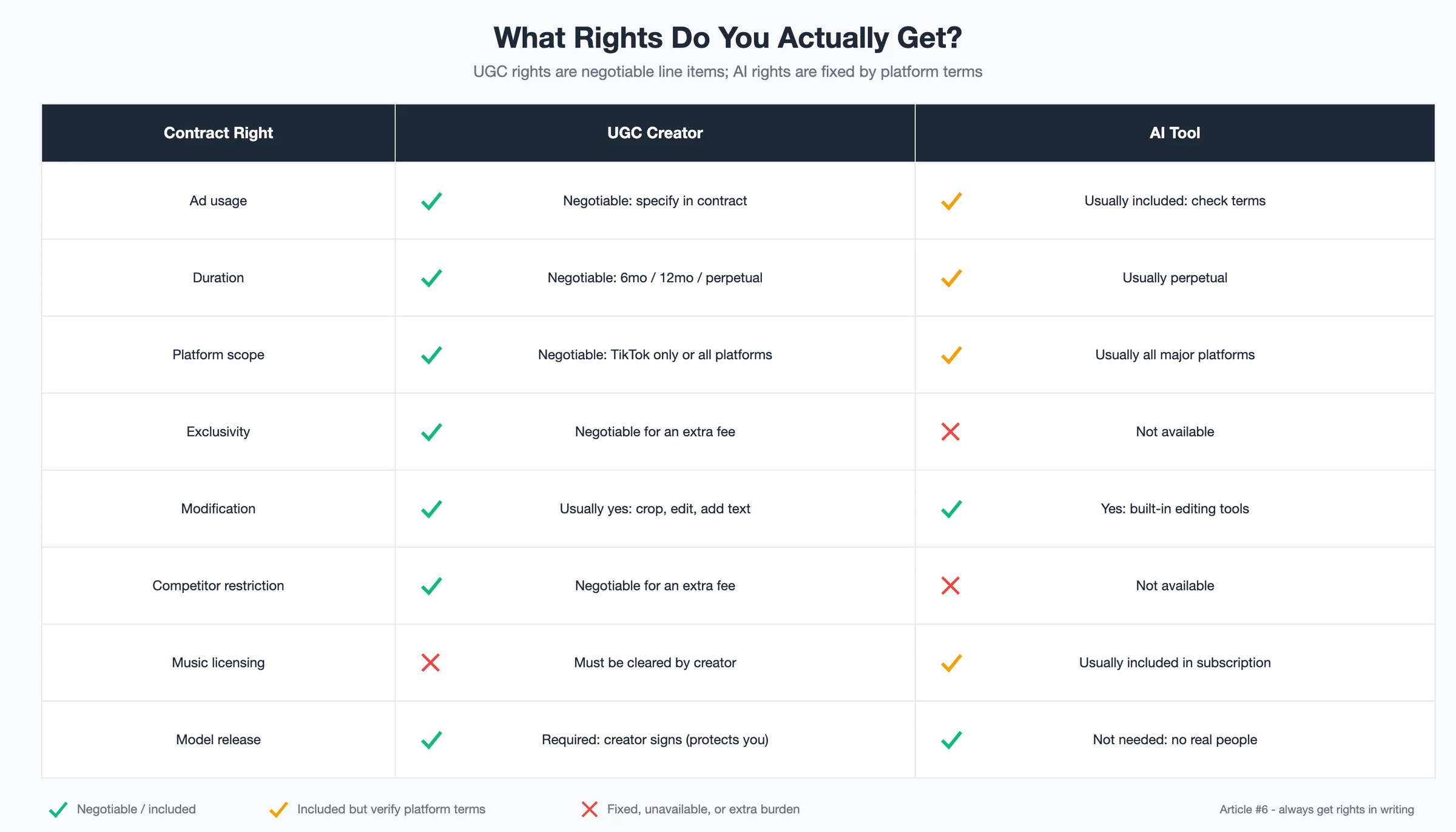
| Right | UGC Creator | AI Tool |
|---|---|---|
| Ad usage | Negotiable (specify in contract) | Usually included (check terms) |
| Duration | Negotiable (6mo/12mo/perpetual) | Usually perpetual |
| Platform scope | Negotiable (TikTok only? All?) | Usually all major platforms |
| Exclusivity | Can be negotiated (extra fee) | N/A (no exclusivity) |
| Modification | Usually yes (crop, edit, add text) | Yes (built-in editing tools) |
| Competitor restriction | Can be negotiated (extra fee) | N/A |
| Music licensing | Must be cleared (creator responsibility) | Usually included in subscription |
| Model release | Required (creator signs) | N/A (no real people) |
Critical insight: With UGC, rights are negotiable line items. You can pay extra for broader scope, longer duration, or competitor exclusivity. With AI, rights are fixed by platform terms—take it or leave it.
Always get rights in writing. Verbal agreements ("you can use this for ads") create dispute risk if the creator later changes their mind or sells to a competitor.
Quality Expectations by Use Case
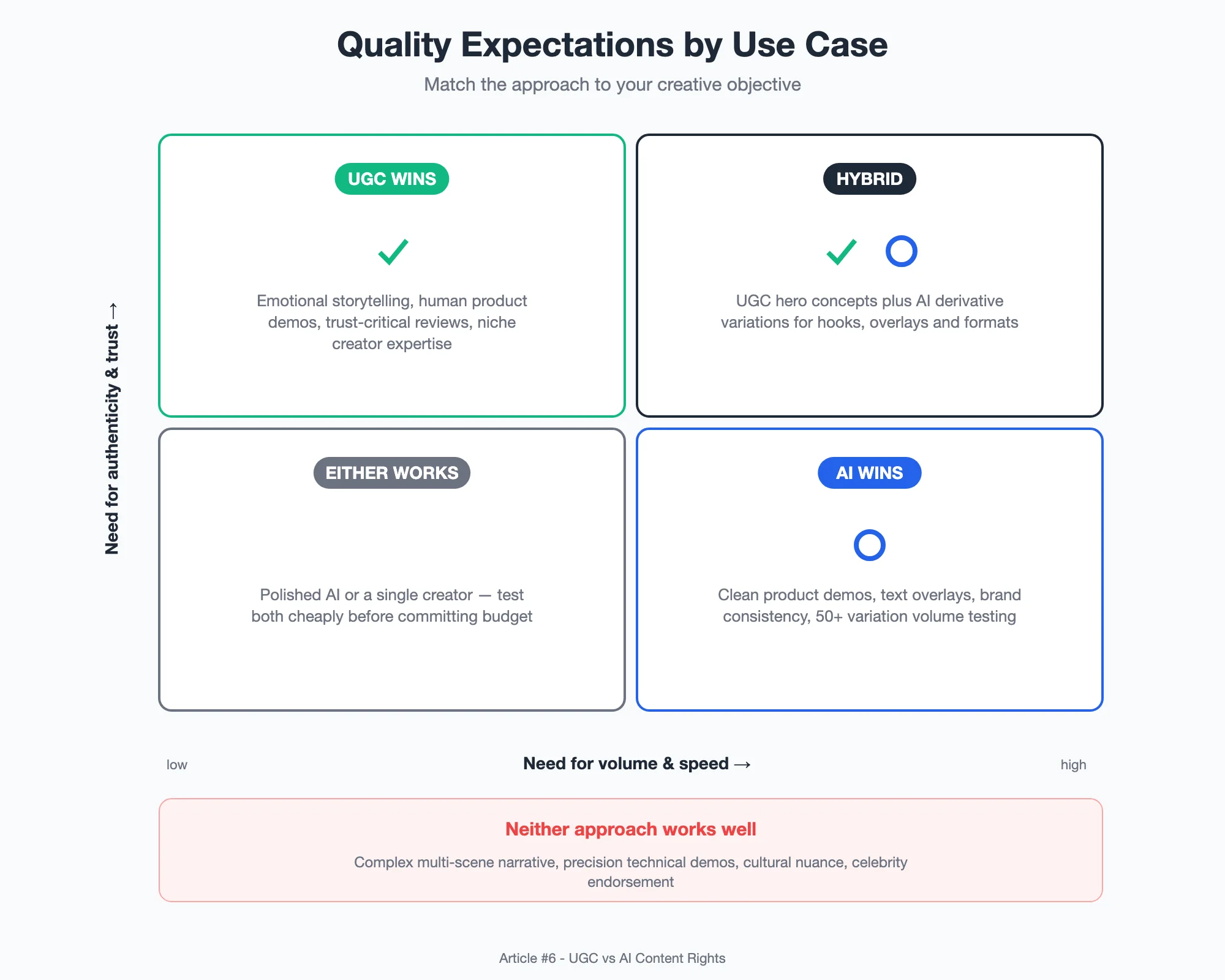
UGC excels when:
- Emotional storytelling matters (brand origin, customer transformation)
- Product demonstration requires human interaction (trying on clothes, using kitchen tool)
- Trust signals are critical (real reviews, authentic reactions)
- Creator niche expertise adds value (beauty guru makeup tutorial, fitness trainer workout demo)
AI excels when:
- Visual simplicity dominates (product on clean background, text overlay, simple animation)
- Volume testing is priority (50+ variations to find winners)
- Brand consistency is paramount (exact logo placement, color accuracy)
- Speed to market critical (launch campaign in days, not weeks)
Neither works well when:
- Complex narrative required (multi-scene story with plot development)
- Physical product demonstration needs precision (technical equipment operation)
- Cultural nuance essential (region-specific humor, local references)
- Celebrity endorsement needed (trust transferred from famous person)
The key insight: match the approach to your creative objective. Don't use AI for emotional storytelling where UGC shines. Don't use UGC for high-volume testing where AI's scalability wins.
Cost Per Usable Asset: A Working Model
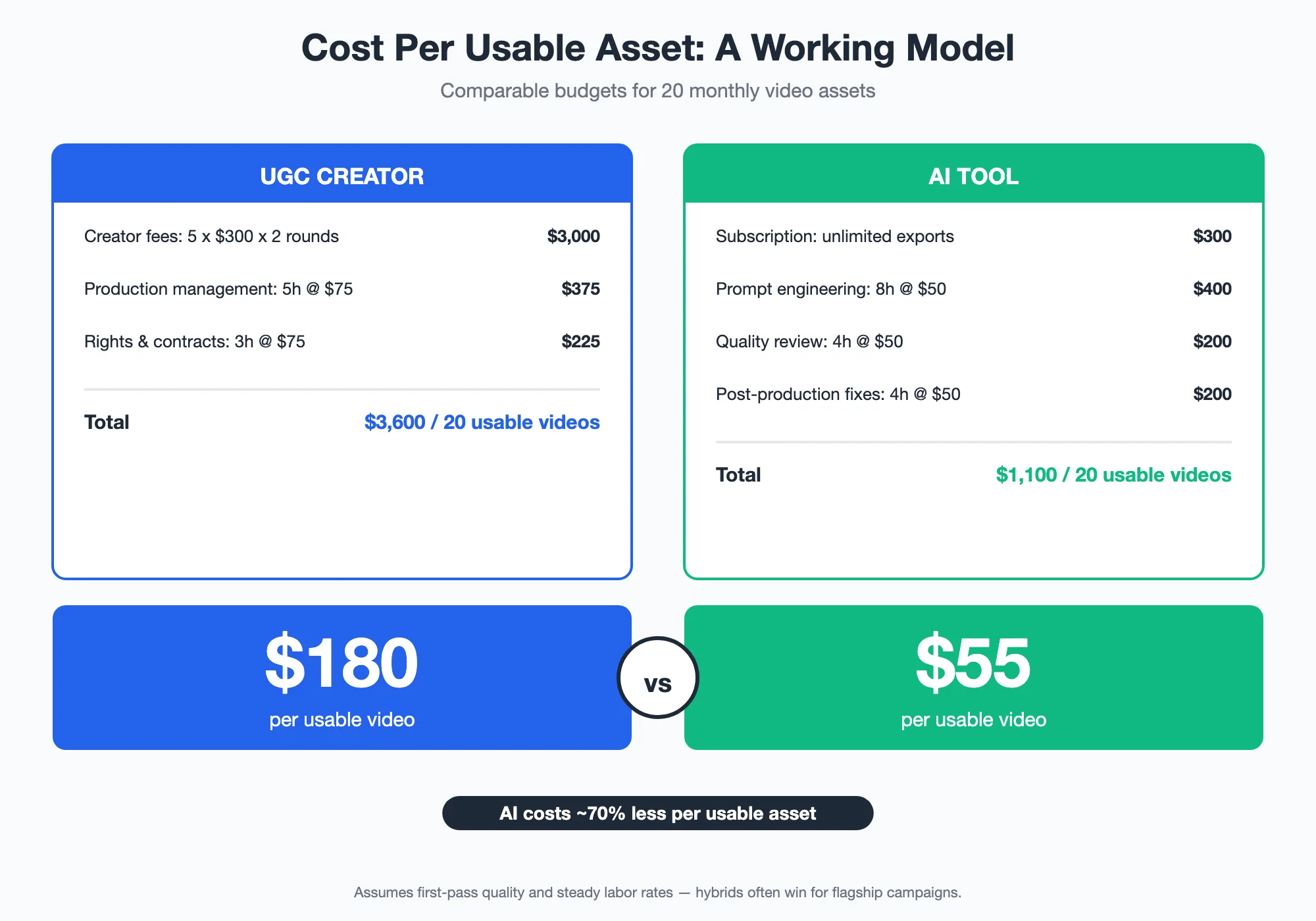
Let's build a comparable model for 20 monthly video assets:
UGC approach:
- Creator fees: 5 creators × $300/video × 2 rounds each = $3,000
- Production management: 5 hours @ $75/hour = $375
- Rights negotiation and contracts: 3 hours @ $75/hour = $225
- Total: $3,600 / 20 usable videos = $180/video
AI approach:
- Subscription: $300/month (unlimited exports)
- Prompt engineering and iteration: 8 hours @ $50/hour = $400
- Quality review and selection: 4 hours @ $50/hour = $200
- Post-production fixes: 4 hours @ $50/hour = $200
- Total: $1,100 / 20 usable videos = $55/video
The AI approach costs 70% less per usable asset. But this model assumes:
- AI outputs pass quality checks on first try (often false)
- UGC requires multiple creator rounds (sometimes one take suffices)
- Labor rates are consistent (they're not)
A more conservative UGC estimate (10 creators, 1 round each): $3,000 + $500 labor = $3,500 / 10 videos = $350/video (worse economics due to lower volume)
A more conservative AI estimate (30% failure rate, more iteration): $1,600 / 14 usable videos = $114/video (still better than UGC)
The takeaway: AI typically costs 50-70% less per usable asset, but quality variance means you may need hybrid approach for flagship campaigns.
When Hybrid Makes Sense
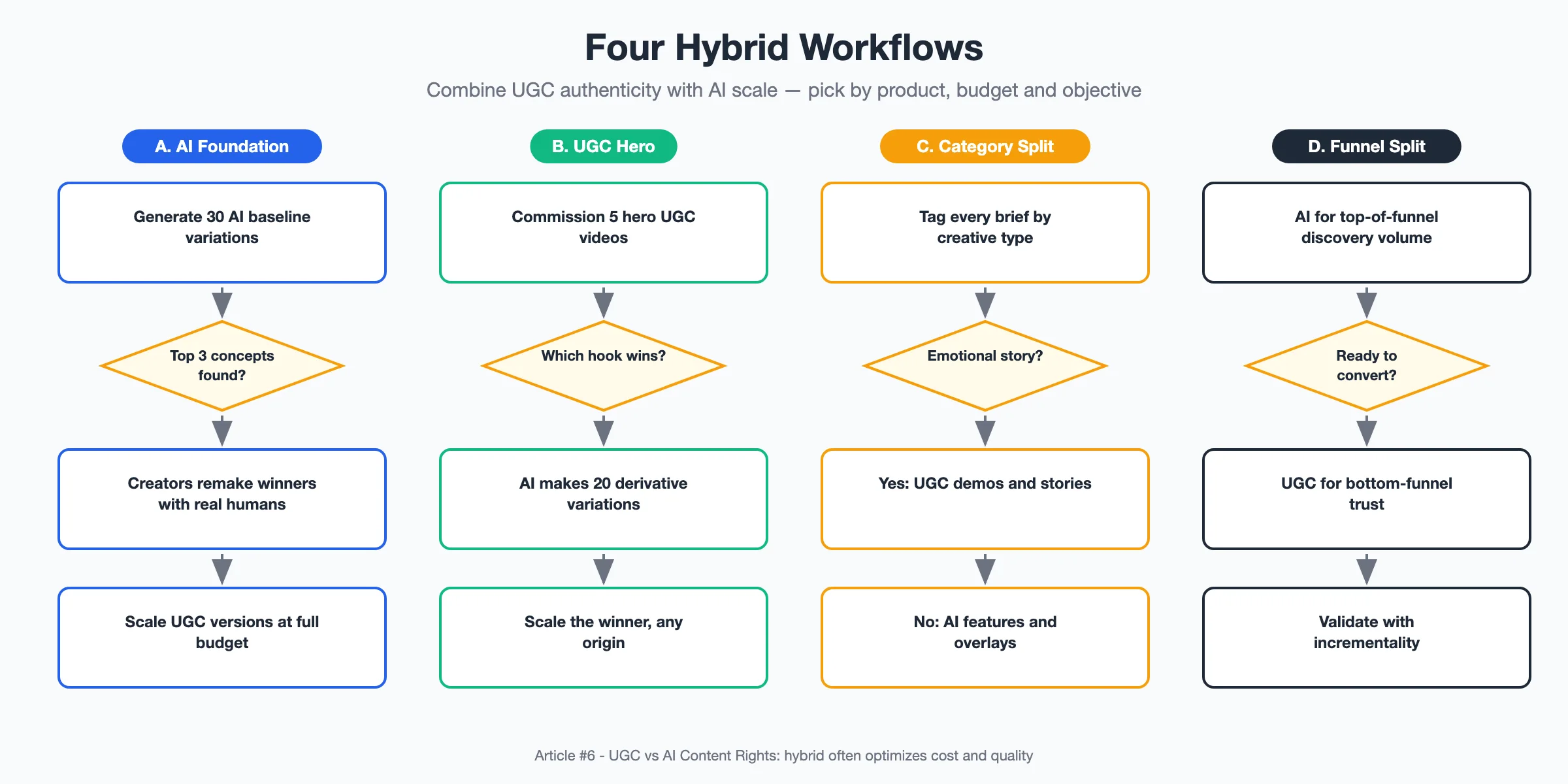
Hybrid UGC-AI workflows often optimize both cost and quality:
Strategy A: AI foundation, UGC enhancement
- Generate 30 AI variations as baseline tests
- Identify top 3 performing concepts
- Commission UGC creators to remake those concepts with human authenticity
- Run UGC versions at scale with larger budget
Strategy B: UGC hero, AI supporter
- Commission 5 high-quality UGC videos from established creators
- Use AI to create 20 derivative variations (different hooks, text overlays, aspect ratios)
- Test AI derivatives against original UGC
- Scale winner regardless of origin
Strategy C: Category split
- Use UGC for emotional/product-demonstration categories
- Use AI for feature/benefit/text-overlay categories
- Allocate budget based on category performance
Strategy D: Funnel split
- Use AI for top-of-funnel discovery (cheaper volume)
- Use UGC for bottom-funnel conversion (higher trust)
- Measure incrementality to validate approach
The hybrid approach acknowledges that neither UGC nor AI is universally superior. Your optimal mix depends on product type, budget size, and creative objectives.
The Real Question: What Does Your Audience Trust?
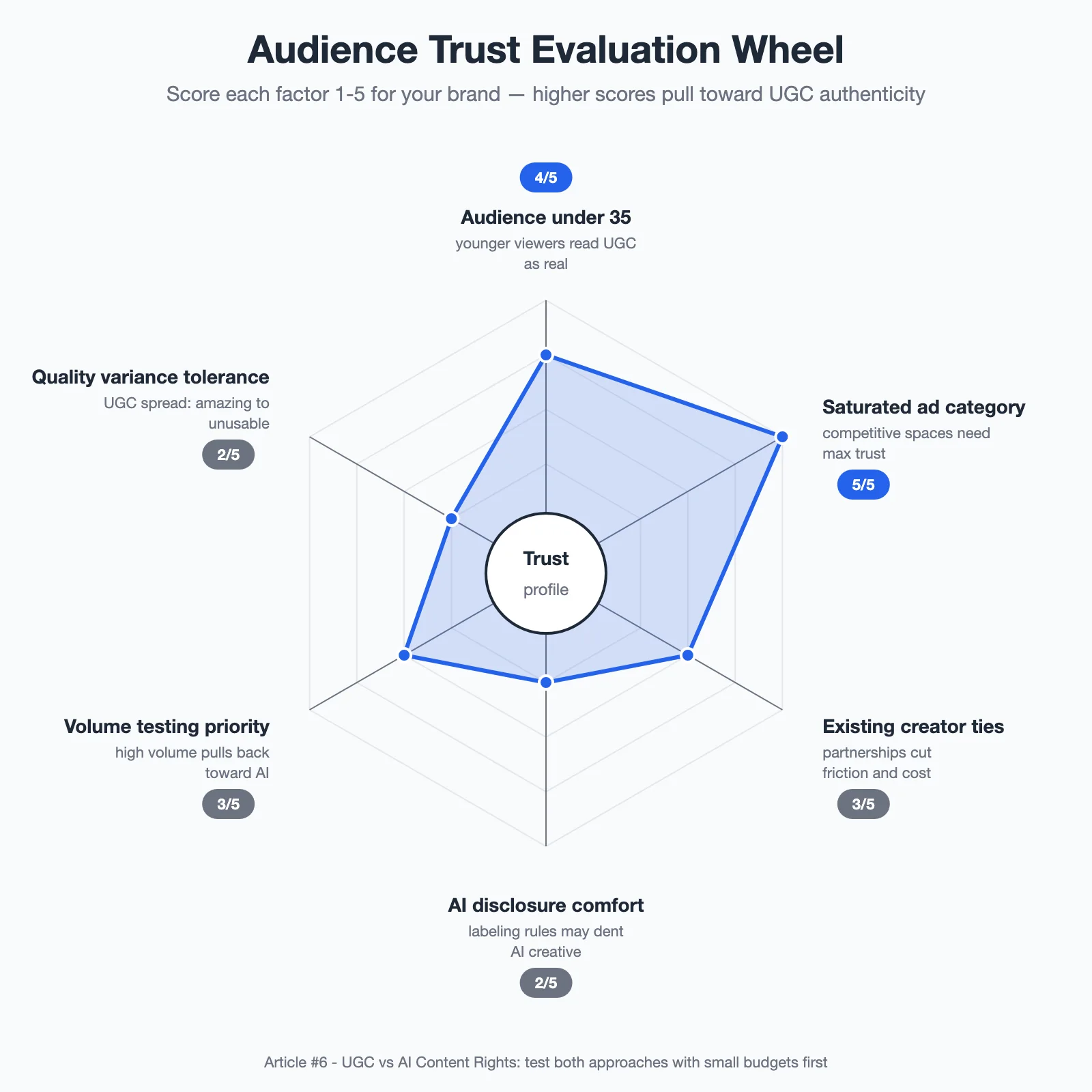
Before investing in either approach, ask:
-
What's my average customer age? Under 35? UGC authenticity signals resonate strongly. Over 45? Polished production (AI or traditional) may perform better.
-
Is my product category saturated with ads? Highly competitive spaces (supplements, weight loss, make money online) require maximum authenticity—UGC wins. Less saturated categories? AI credibility gap smaller.
-
Do I have existing creator relationships? Leveraging ongoing partnerships reduces friction and cost. Starting from zero? AI lowers barrier to entry.
-
Am I comfortable with AI disclosure trends? Some platforms may soon require labeling AI-generated content. If transparency matters to your brand, factor this into decision.
-
What's my acceptable quality variance? UGC has wider spread (some amazing, some unusable). AI more consistent but with ceiling on emotional resonance. Match to your tolerance.
Your audience's trust preferences matter more than vendor capabilities. Test both approaches with small budgets before committing major spend.
Sources:
- Creatify AI UGC Content Guide – UGC definition and marketing applications
- Genape AI UGC Tools 2026 – AI UGC tool landscape
- SitePoint AI Video QA – Quality assurance principles
- Overseas CMCM A+ Creative – Automation insights applicable to AI production