Frame-by-Frame: How I Rebuild a Losing Ad Into a Winner
I stopped tweaking losing ads on instinct. Now I audit them frame by frame, find the retention breakpoint, and change exactly one thing per round.
Practitioner playbook — a composite field guide written from the perspective of a DTC Brand Operations Lead. Figures are illustrative, not verified client results.
The first time I tried to fix a losing ad, I did what most people do: I changed the hook, then the music, then the thumbnail, then everything again, and prayed to the algorithm. The ad kept losing, and I couldn't tell you which of my six "fixes" had helped or hurt. That ad eventually died with a graveyard of unattributed edits behind it.
What changed my results wasn't a better tool or a bigger budget. It was a boring discipline: I now rebuild losing ads frame by frame. I treat the creative like a film edit instead of a black box — every second has a job, every job either gets done or gets cut, and every rebuild round changes exactly one thing so I can actually learn something.
This piece is the workflow I run on any ad that had a decent launch and then bled out: how I audit the frames, where ads almost always break, how I read retention curves for breakpoints instead of vibes, and the checklist I force myself through before anything goes back into rotation. All numbers are illustrative rules of thumb — ranges that worked for accounts like mine, not promises about yours.
Step One: I Audit the Ad Like a Stranger, Not Like the Owner
Before I touch a single setting, I sit down and watch my own ad the way a cold stranger would. My process is deliberately slow:
- Export the ad and scrub second by second. I take a screenshot of every second of the first 6 seconds, and every 2 seconds after that. Roughly 20–25 frames for a 30-second ad.
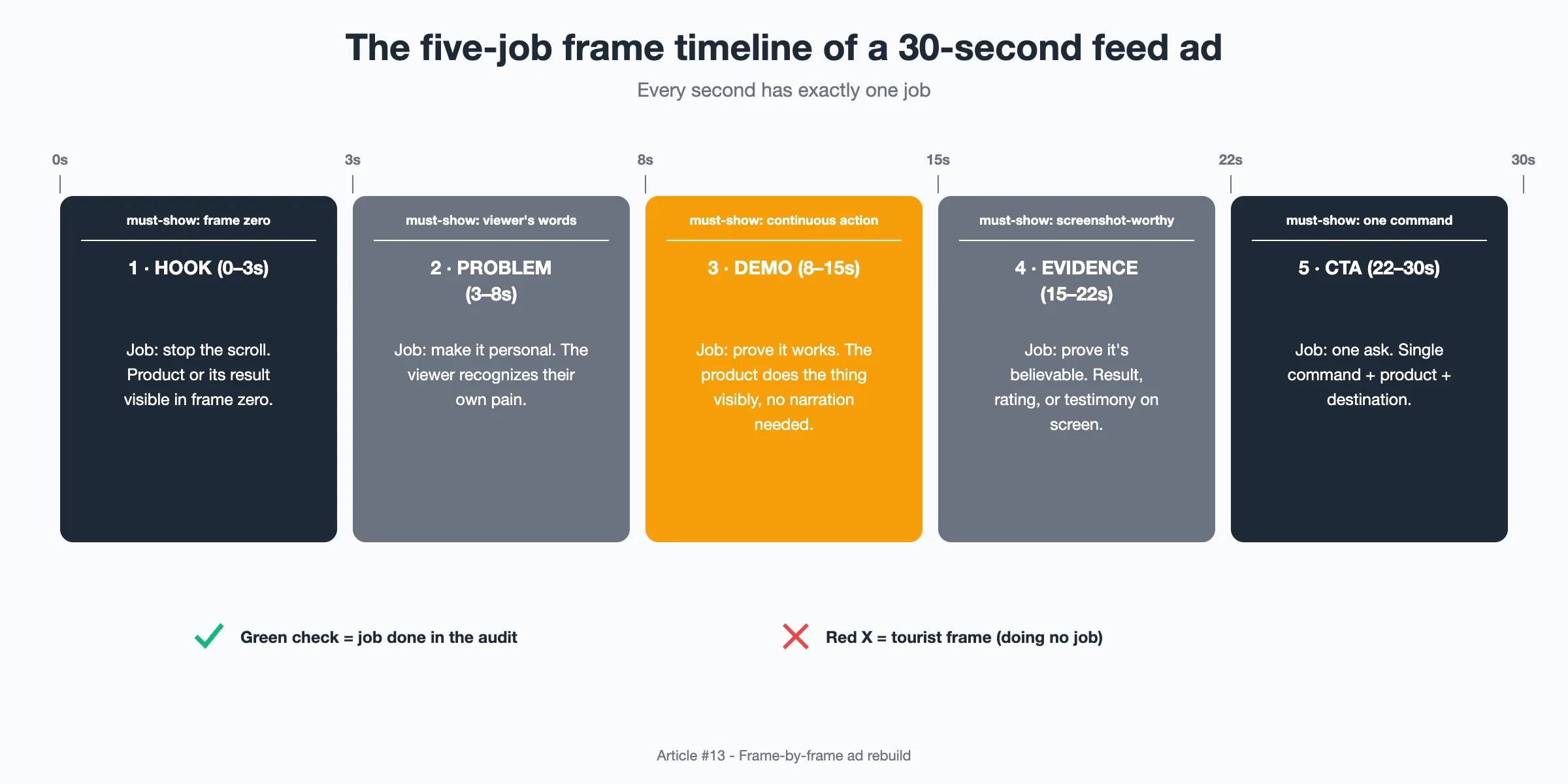
- Label every frame with a job. Each frame is doing exactly one of five things: hooking, naming the problem, demonstrating the product, proving it, or asking for the click. If a frame is doing none of those, it's a tourist.
- Watch it muted first. If the story doesn't survive silence, the frames are leaning on narration they can't afford.
- Watch it at 2x speed. Whatever felt "cinematic" at 1x now feels like a slideshow. That feeling is data.
- Write one sentence per frame: "At second 4, a stranger knows ___." If I can't fill the blank, that's a hole in the ad, not in the audience.
The single most valuable output of this audit is a segment map — the ad chopped into five blocks, each with an explicit job and a time window. Everything downstream (diagnosis, rebuild, retest) hangs off that map.
Step Two: I Find the Breakpoint Before I Find the Fix
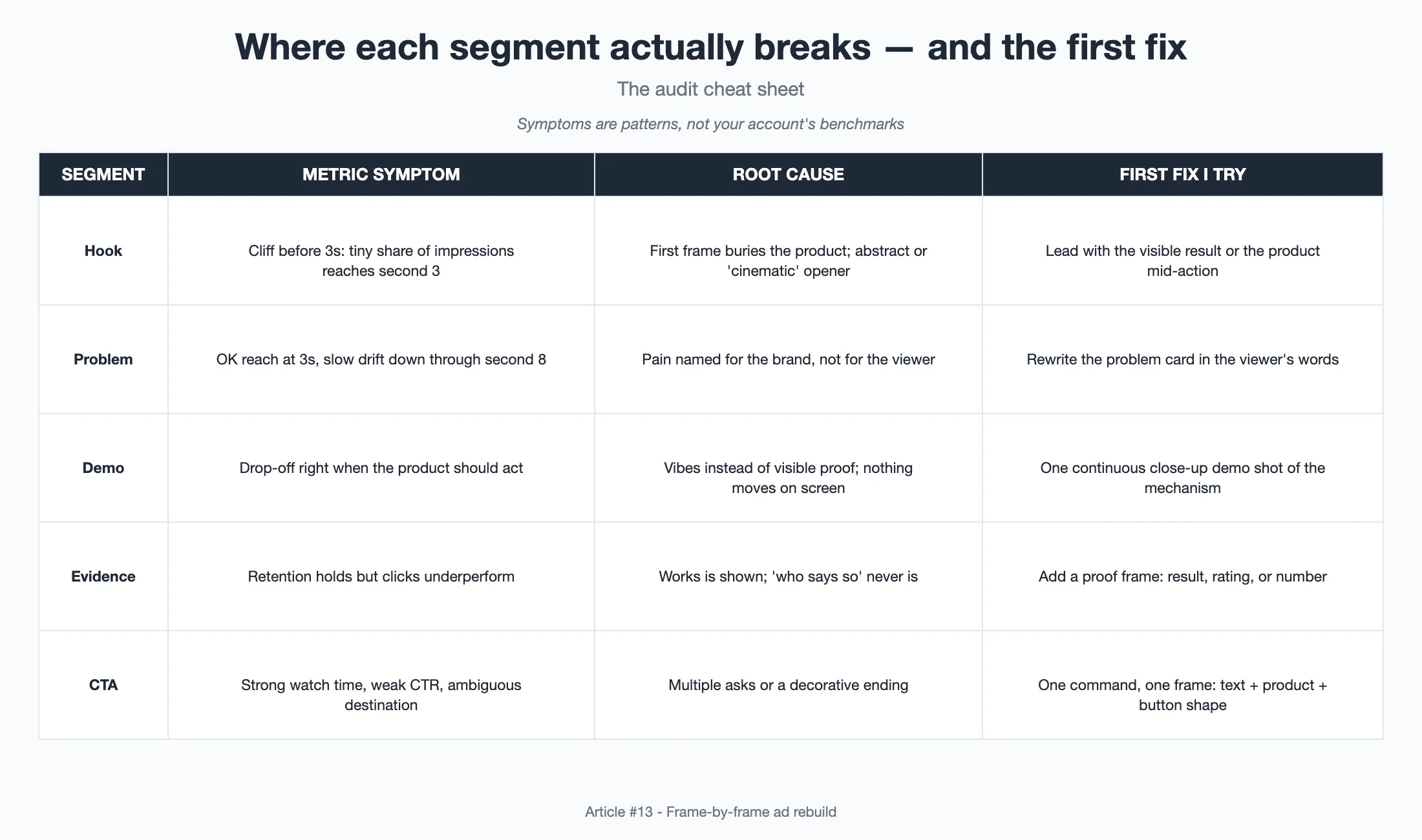
Most "bad ads" aren't bad overall — they're one broken segment dragging a mostly-fine ad into the grave. So before I rewrite anything, I match my audit notes to the failure patterns that show up most often. The diagram's table is my cheat sheet: per segment, the symptom in metrics, the root cause, and the first fix I try.
A few patterns worth spelling out:
- Hook failures show up as a cliff, not a slope. If a huge share of impressions never reaches second three, the problem is almost always the first frame or the first on-screen line — not the "concept."
- Problem-segment failures look like polite disengagement. People watch but don't feel addressed. My tell is decent 3-second reach with a slow drift down through second 8.
- Demo failures are curiosity killers. Viewers wanted proof the thing works and got vibes instead. I look for drop-off precisely when the product should have done something visible.
- Evidence failures are trust gaps. Retention holds but clicks underperform. The ad proved it works but never proved who says so.
- CTA failures are the cheapest to fix and most often ignored. Great video, ambiguous ask. If viewers can't finish the sentence "so they want me to ___," the last five seconds are being decorative.
Step Three: The Retention Curve Tells Me Where, Metrics Tell Me How Bad
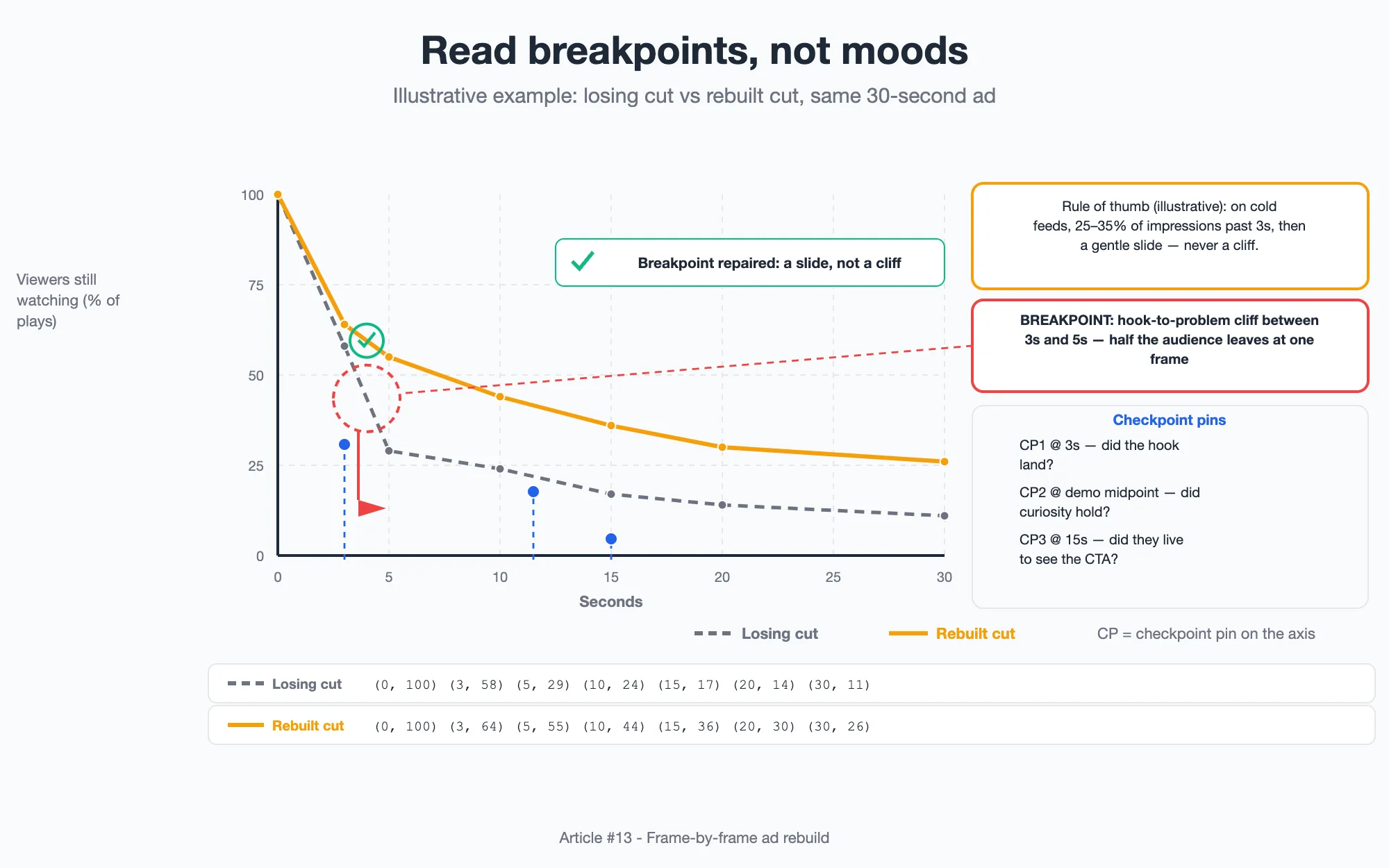
Here's how I actually read the numbers, using my own thresholds as working assumptions rather than laws. I pull the video watch curve from the ad platform and mark three checkpoints on it: 3 seconds (did the hook land?), the demo midpoint (did curiosity hold?), and 15 seconds (did enough people live long enough to see the CTA?).
As a personal rule of thumb, on cold feeds I expect roughly a quarter to a third of impressions to survive the 3-second mark, with a further gentle slide rather than a cliff after that. An ad that reaches, say, 60% at 3 seconds and then loses half its viewers by second 5 doesn't have an engagement problem — it has a broken frame right at the 5-second mark. That's a breakpoint — and breakpoints are where rebuilds start.
Three habits keep me honest here:
- I annotate the curve with my segment map. Every steep drop gets pinned to a timestamp, and every timestamp gets matched to the frame I screenshotted. No "the ad just feels tired" conclusions.
- I compare curves between variants, not curves to some universal benchmark. A healthy curve and a sick curve for my account and my audience beat any industry average I can't verify.
- I treat small samples as noise. Below roughly 1,000 impressions or 50 clicks on a variant, I don't read the curve. I wait.
Step Four: One Change Per Round, Logged Like a Lab Notebook
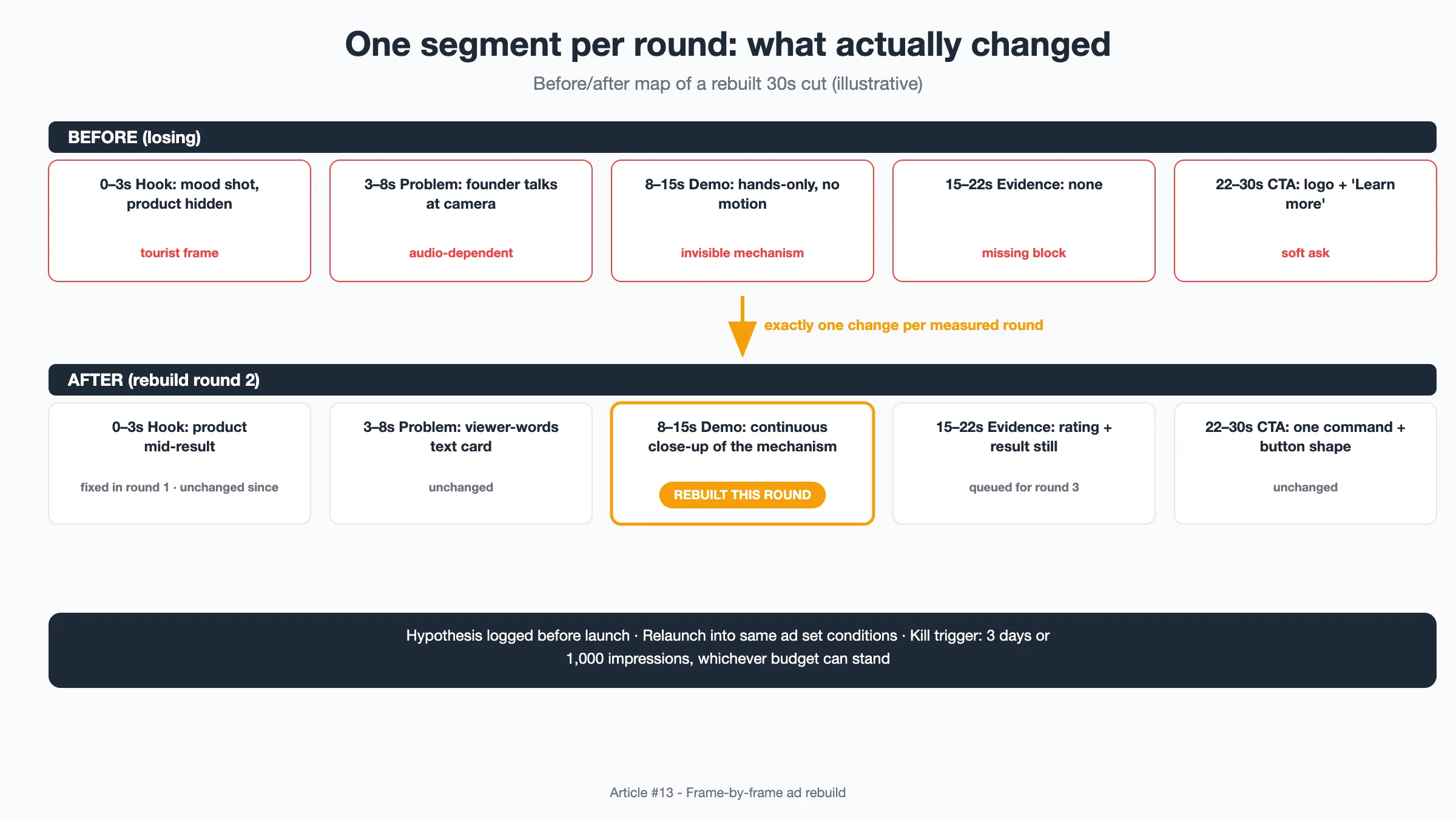
This is the step that ended my edit-soup era. Each rebuild round changes exactly one segment — the one at the worst breakpoint — and nothing else. New hook, same middle and end. Then, if the hook is fixed, next round I touch the demo. One variable, one verdict.
My rebuild rounds work like this:
- Pick the earliest, steepest breakpoint. If both the hook and the demo are broken, I fix the hook first — no point polishing an ad nobody watches past second 3.
- Rebuild only that segment. This is where AI video generation genuinely changed my ops: I re-render the broken block — new opening frame, new demo shot, new evidence card — while keeping the rest of the cut pixel-identical. The cheaper it is to regenerate one segment, the more rounds you can afford, and rounds are the whole game.
- Log the hypothesis before launch. One line in a shared sheet: "Frame 0–3 currently buries the product; hypothesis: leading with the visible result lifts 3-second survivors into the mid-30% range." If I can't write the hypothesis, I'm not changing the ad, I'm rolling dice.
- Relaunch into the same ad set conditions — same audience, same placement, comparable daypart — so the curve comparison means something.
- Kill the round after a pre-set trigger window. My default is 3 days or 1,000 impressions, whichever comes later, whichever my budget can stand.
Two to four rounds is usually the honest lifespan of a rebuild. If an ad still bleeds after fixing its third breakpoint, I stop rebuilding and start asking whether the offer, not the edit, is the problem.
Step Five: My Pre-Relaunch Diagnostic Checklist
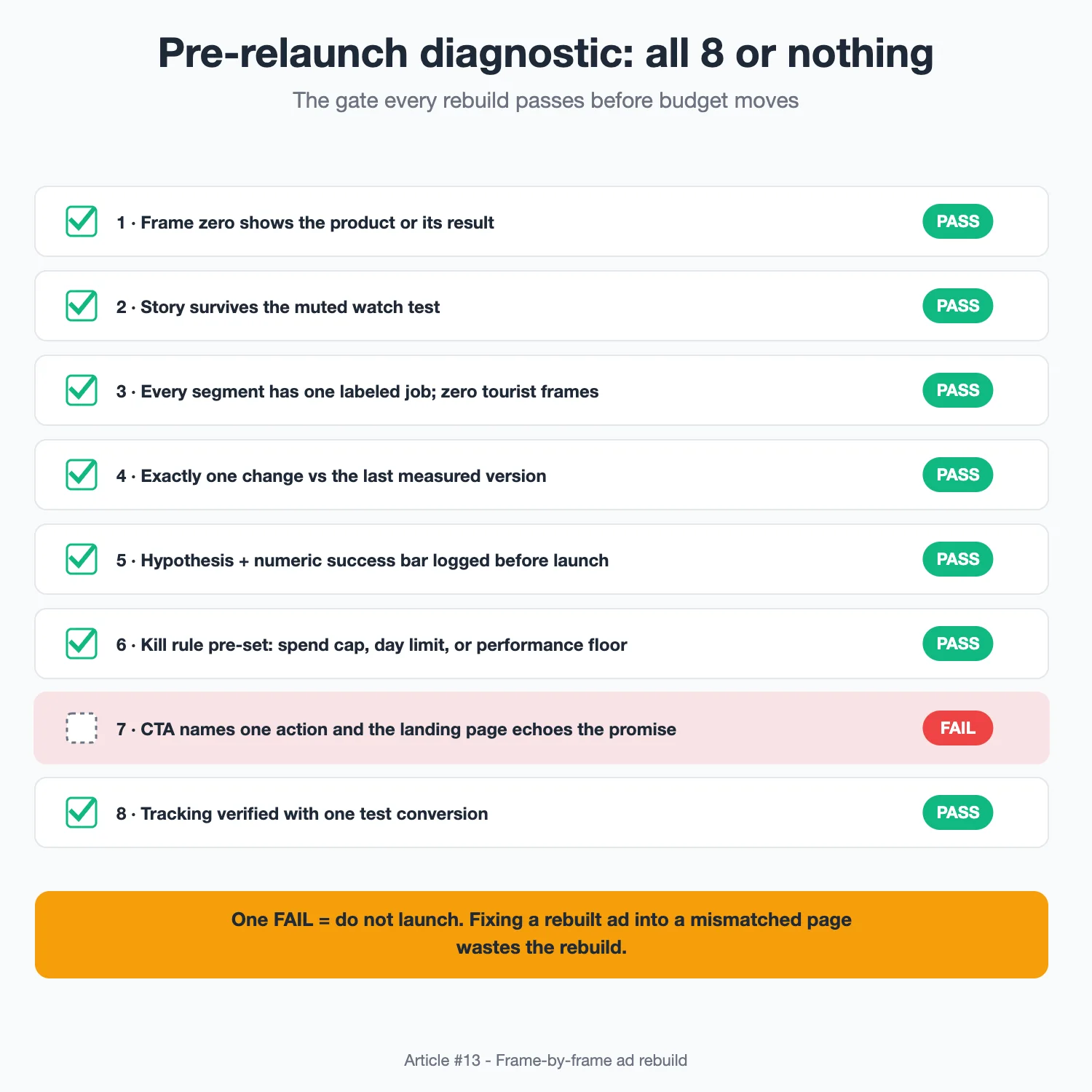
Before any rebuilt ad goes back into rotation, it has to pass the checklist in the diagram above. The short version of why each item exists:
- Frame zero shows the product or its result. The prettiest abstract opener is still an escape hatch for not committing.
- The muted watch test passes. Someone who knows nothing about the brand can follow the story with sound off.
- Every segment has a labeled job and no frame is a tourist.
- Exactly one change versus the last version that earned data. Two changes, zero learning.
- A written hypothesis and a numeric success bar exist in the log before launch.
- A kill rule is set in advance. Spend cap, day limit, or performance floor — decided now, not by a stressed human later.
- The CTA names one action and the landing page echoes the ad's promise. A rebuilt ad pointed at a mismatched page is a rebuilt ad wasting budget.
- Tracking fires. One test purchase or test form submit before scale, because broken pixels make ghost stories of every number above.
I fail more rebuilds at this stage than in the data. That's the point.
Budget Rules So Rebuilds Don't Quietly Fund a Hobby
Rebuilds only work if they're cheap enough to run many of. My budget discipline, again as illustrative ranges for a lean DTC ops setup:
- Cap each test round. I size a rebuild round at roughly 2–3x my target CPA in spend — enough to buy a real read, small enough that a loss is a line item, not an incident report.
- Keep losers' budgets separate from winners' scaling. Rebuild rounds run in a dedicated test ad set. The main campaign never absorbs "just one more week" of a failing variant.
- Minimum viable data before any verdict: on the order of 1,000 impressions or 50 clicks per variant, whichever the objective gives faster. Under that, everything is vibes.
- Retire, don't hoard. If a concept has failed three rebuild rounds at different breakpoints, the concept is the finding. Archive it with its log, and brief a new angle.
The meta-point: budget rules protect the attribution rules. One change per round only pays off if rounds stay affordable enough that you choose clean tests over desperate ones.
The Real Question: Is This Ad Losing, or Is It Done?
A frame-by-frame rebuild can rescue an ad that lost its footing. It cannot rescue an ad that was answering a question nobody under thirty — or over fifty, or outside my niche — was asking. So the last diagnostic I run isn't on the timeline or the retention curve. It's on the brief: does this creative say something a stranger would want to hear about their problem, with a product they'd plausibly want? If yes, rebuild the frames until the numbers agree. If no, the kindest frame I can edit is the one where I let the ad go.
Sources:
- Meta Ads Manager help docs – definitions for video ad metrics like 3-second plays, ThruPlay, and impression-based reporting windows.
- TikTok Ads Manager and Creative Center resources – how ad watch-time and retention curves are surfaced for feed placements.
- Google Ads video measurement documentation – conventions for view-based reporting and creative benchmarking on YouTube placements.
- Baymard Institute and Nielsen Norman Group usability research – general principles on message match between ads and landing pages, and short-attention scanning behavior.
Disclosure: This piece is written from a practitioner's perspective to share a working method. It is not a customer testimonial, and any numbers are illustrative examples, not guaranteed outcomes.